A perennial border that flowers all summer: plants, layout, numbers
A perennial border flowers from spring to autumn when its backbone is long-flowering perennials that bloom from June to September (catmint, woodland sage, coneflower, yarrow, Russian sage, gaura), with bulbs around them for spring and Japanese anemone, sedum and asters for autumn. Plant in groups of 3-7, tall at the back, low at the front; on average you need 5-7 plants per square metre. The calendars show the hardy perennials for a sunny spot that shops in your country sell most widely, with the price per plant.
Updated: October 24, 2026 · Data and prices from our plant database, worked out for your country. How our data is made

What makes it flower all summer?
No perennial flowers from March to October. A border that is colourful all summer has three layers: the backbone is long-flowering summer perennials that bloom for two to four months; before them, bulbs carry the colour in spring, and after them, late perennials in autumn. With two or three kinds for each month, no month is empty.
Most long-flowering perennials want sun and free-draining soil, and many take drought well. So the calendars are for a sunny border; for part shade, choose from perennials for part shade.
The backbone: perennials from June to September
These perennials flower from June to at least August, many into September or October. For a blue-violet base, catmint, woodland sage and Russian sage are good; beside them coneflower for pink, yarrow and threadleaf coreopsis for yellow, and white gaura for an airy touch.


 Lily
0.3–2.4 m
€7.50


 Red hot poker
0.6–1.2 m
€7.90
 Shasta daisy
0.6–1.2 m
€4.50


 Red bistort
0.7–1.2 m
€4.60

The calendar shows the summer-long perennials that shops sell most widely, that take full sun and survive an average winter. Those marked “drought-tolerant” also suit a border in full sun without watering. The price is the typical price of a plant of the usual size in your country. You find all of them in the perennials that flower all summer list.
Spring and autumn: bulbs and late flowers
In April and May the summer perennials are only in leaf. Until then the bulbs bring the colour: crocus, grape hyacinth, daffodil, tulip, scattered between the plants. They are planted in autumn, from September to November. Our garden planner counts 20 small bulbs (crocus, grape hyacinth), 8 medium and 4 large per square metre.
From late August the late perennials take over: Japanese anemone, border stonecrop and bushy aster flower into October.
 Crocus
8–15 cm
€5.90
 Daffodil
15–75 cm
€4.90
 Grape hyacinth
15–25 cm
€3.90

 Hyacinth
15–30 cm
€3.90
 Crown imperial
0.9–1.2 m
€6.40
 Garden tulip
20–75 cm
€5.90

 Bushy aster
20–60 cm
€5.90

How to lay out the border
The tallest perennials go at the back, in front of the wall or fence, the medium ones in the middle, the low ones at the front, by the edge. Do not draw straight lines between the groups: let the drifts run at an angle, slipping into each other a little.
- Plant few kinds in large drifts: 6-9 kinds are enough for a 2 × 5 m border, 3-7 plants of each. A single plant gets lost; perennials planted in drifts show from afar.
- Repeat: let one or two kinds (say catmint at the front, Russian sage at the back) come back two or three times along the border. That is what makes it look of a piece.
- Choose two or three main colours, and put white or silver-grey between them. Blue-violet goes with almost anything.
- Add some ornamental grasses: in autumn and winter they give the shape when the flowers are over.
How many plants?
The number comes from each plant's planting distance; set them in a triangular pattern, in staggered rows. Low perennials (30 cm apart) take about 13 plants per square metre, medium ones (40 cm) about 7, tall and broad, bushy perennials (60-70 cm) 2-3. In a mixed border that averages 5-7 plants per square metre.
- A sunny 2 × 5 m border of 10 m² thus takes 50-70 perennials. If you also plant bulbs between them in half the border, that takes about 160 bulbs in autumn.
- A perennial from a small pot catches up with a large one in a year or two: the calendar's price is for the usual size, and a larger one is rarely worth buying.
- In the first year soil still shows between the plants. Cover it with 5 cm of mulch, and weed until they close up by the third summer.
Cutting back and care
- After the first flush, in late June or July, cut catmint, woodland sage and cranesbills back by half: they regrow within two or three weeks and flower a second time in August and September.
- Deadhead shasta daisy, coreopsis and gaura regularly: they keep making new flowers for longer.
- Do not cut everything down in autumn: the stems of coneflower, sedum, Russian sage and the grasses look good in winter and feed the birds. Cut the dry stems at the end of February, before new growth.
- Water regularly in the first summer after planting; after that the drought-tolerant perennials mostly do without. Feed sparingly: in rich soil salvias and catmint flop.
- Every three or four years, in spring or autumn, lift and divide clumps that have grown large and gone bare in the middle; coneflower and Russian sage are better left undisturbed.
A plan for your own garden
Our garden planner's Colourful flower bed style works by the same rules: it chooses plants so that something flowers in every month from April to September, fills spring with bulbs, arranges the plants in drifts and layers, and works out the numbers and the price in your country. On the picture drawn onto your photo it also shows how the border looks in the 1st, 3rd and 5th summer.
More guides
 How to plan a garden, step by step
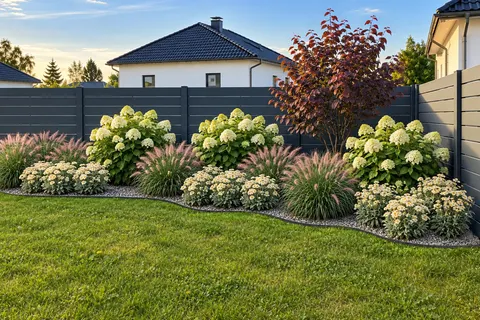
A garden is best planned in six steps: survey the site (light, soil, water, winter), decide what you will use it for, set the framework that still shows in winter, then lay out the border in layers, tall at the back and low at the front. Choose plants so that something flowers from spring to autumn, and finally work out the number of plants and the cost from the planting distances. Our garden planner works by the same rules.
 Fast-growing hedges: how much each grows in a year
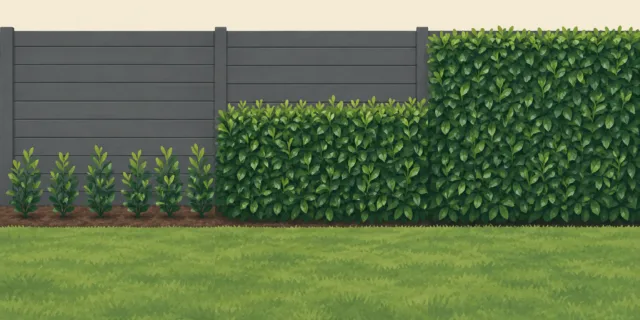
The fastest hedge plant is the Leyland cypress, growing about 90 cm a year, followed by cherry laurel 'Novita', firethorn and western red cedar at about 50 cm a year, then privet at 40 cm. How long a 180 cm hedge takes to screen depends more on the size of plant you buy: several years from small plants, one or two summers from large ones, but at many times the price per metre. The tables use the current shop prices in your country.
 Ground cover plants against weeds: which goes where, and how many you need
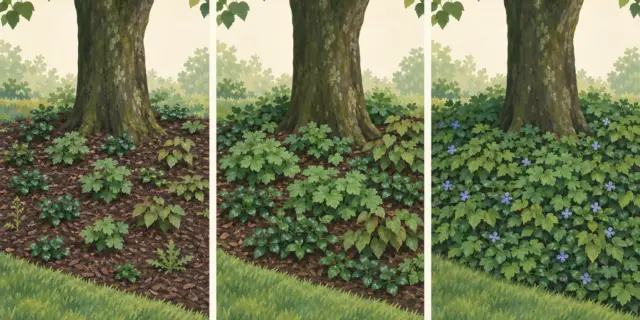
A ground cover keeps weeds out once it has closed up: until then, usually for two or three summers, it needs mulch and weeding. Under trees and in shade, lesser periwinkle, bigroot geranium, barrenwort, barren strawberry and Japanese spurge do best; in sunny, dry places stonecrops, thymes and creeping junipers. Most perennial ground covers take 9-18 plants per square metre. The tables work out what a square metre costs at today's shop prices in your country.
 Planting a hedge: how many plants per metre, and what it costs
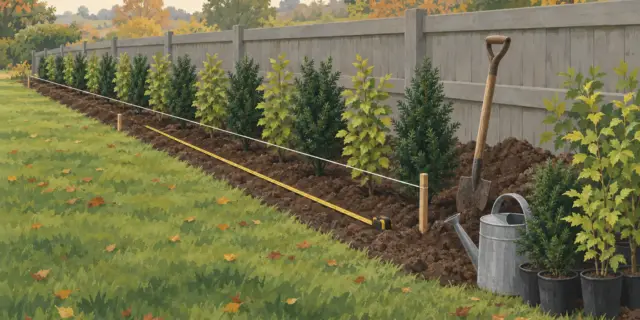
Most hedge plants go in at 2-4 plants per metre: Leyland cypress 2, cherry laurel and photinia 2.5 (40 cm apart), yew 3, hornbeam 3.5, privet and beech 4. The plants go in one row, 80 cm from the fence, in autumn or early spring. What the hedge costs depends most on the size of the plants: the table works it out at today's shop prices in your country, for the length of your own hedge.
 Building a rock garden: stone, soil and plants step by step
A rock garden belongs on a sunny, gentle slope, in lean, free-draining soil: one third garden soil, one third coarse sand, one third crushed stone. Lay the stones, all of one kind, in layers leaning the same way and sunk a third to a half into the ground, so that about two fifths of the surface is stone. Four to six plants per square metre are enough: creeping junipers and grasses make the frame, and between them cushion perennials, stonecrops and thymes flower from March to October.