Pruning roses: which to cut back when, and how hard
Prune roses in spring, in March, as the buds begin to swell (the old rule says: when the forsythia flowers). Cut the strong stems of hybrid tea roses back to 10-15 cm, 4-6 buds, and those of floribundas to 25-30 cm; shrub and ground cover roses only lightly, by a third. Tie the main canes of a climbing rose horizontally and cut the flowered side shoots back by two thirds. Always cut at a slant, about 5 mm above an outward-facing bud.
Updated: November 11, 2026 · Prices checked: November 9, 2026 · Data and prices from our plant database, worked out for your country. How our data is made

When to prune roses?
The main pruning is in spring, in March, once the hard frosts are over and the buds begin to swell. The old gardeners' rule says: when the forsythia flowers. Prune earlier and a late frost can take the fresh growth; later and the rose has put its strength into the part you cut off.
In mild-winter areas you can prune a climbing rose at the end of winter too, on a frost-free day; in colder places rather in March. A once-flowering rambler that grows long canes and flowers in June, however, is pruned in summer after flowering, because next year's flowers open on the canes grown during the summer.
By rose group
How much to cut depends on the rose's group. Hard pruning gives the large-flowered hybrid tea fewer but larger flowers on long stems; the cluster-flowered floribunda keeps longer stems to carry more flowers; shrub roses and ground cover roses look best in their natural form and need hardly any pruning.

- Height
- 0.8–1.8 m
- When to prune
- March, before new growth
- How hard
- hard: strong stems to 10-15 cm, 4-6 buds
- Price per plant
- €19

- Height
- 0.4–1.5 m
- When to prune
- March, before new growth
- How hard
- moderately: stems to 25-30 cm
- Price per plant
- €20

- Height
- 1–2.5 m
- When to prune
- March, before new growth
- How hard
- lightly: by a third, 1-2 old stems at the base
- Price per plant
- €7.90

- Height
- 1.8–6 m
- When to prune
- end of winter or March
- How hard
- flowered side shoots by two thirds
- Price per plant
- €20

- Height
- 30–90 cm
- When to prune
- March, before new growth
- How hard
- lightly: thinning, renewal every few years
- Price per plant
- €6.80

- Height
- 20–60 cm
- When to prune
- March, before new growth
- How hard
- stems by half
- Price per plant
- €36
|
Rose
|
Height
|
When to prune
|
How hard
|
Price per plant
|
|---|---|---|---|---|
|
Hybrid tea rose
Deciduous
|
0.8–1.8 m | March, before new growth | hard: strong stems to 10-15 cm, 4-6 buds | €19 |
|
Floribunda rose
Deciduous
|
0.4–1.5 m | March, before new growth | moderately: stems to 25-30 cm | €20 |
|
Shrub rose
Deciduous
|
1–2.5 m | March, before new growth | lightly: by a third, 1-2 old stems at the base | €7.90 |
|
Climbing rose
Deciduous
|
1.8–6 m | end of winter or March | flowered side shoots by two thirds | €20 |
|
Ground cover rose
Deciduous
|
30–90 cm | March, before new growth | lightly: thinning, renewal every few years | €6.80 |
|
Miniature rose
Deciduous
|
20–60 cm | March, before new growth | stems by half | €36 |
The table shows the rose groups. The price is the typical price of a potted plant of the usual size; where it is empty, that group is not on offer in your country at the moment. Prune newly planted hybrid teas, floribundas and miniature roses hard in their first spring too, so they send up strong shoots from the base; do not cut climbing and shrub roses back in their first year, only damaged stems.
How to cut?
- First cut out anything dead, diseased, damaged or as thin as a pencil, and anything that grows inwards, into the middle of the bush, or crosses another stem. Cut a dead stem back to white, healthy pith.
- Cut the remaining stems just above an outward-facing bud, about 5 mm above it, at a slant sloping away from the bud so water runs off. The middle of the bush stays open and airy: less black spot and powdery mildew.
- Use sharp secateurs, and loppers or a pruning saw for thick, old stems. Do not leave a stub: no new shoot grows from it, it only dies back.
- On an old plant, cut one or two of the oldest stems with grey bark that flower poorly out at the base each year: young, strong stems grow in their place.
Pruning a climbing rose
- Tie the main canes of a climbing rose as horizontally as you can to the fence, wires on the wall or a pergola. A horizontal cane grows many flowering side shoots; an upright one only at the top.
- Cut the flowered side shoots back by two thirds. Do not cut off new, long canes but tie them in: they become the main canes of the coming years.
- You can rejuvenate an old, bare climbing rose from late autumn to the end of winter: cut a few old canes out at the base, keep no more than six young, strong canes, and shorten the side shoots by a third to a half.
Summer and autumn tasks
- In summer, regularly cut off faded flowers just above the first full leaf of five leaflets: a repeat-flowering rose then makes new buds sooner.
- Do not cut off a sucker coming from below the graft at the base (often with different leaves, seven leaflets), but follow it to the root and pull it off there; cut, it grows back more.
- In autumn, shorten the long, whippy canes of hybrid teas and floribundas by a third so winter wind does not loosen the plant; shrub and ground cover roses usually do not need it. Do not do the main pruning yet.
- In colder areas, mound 15-20 cm of soil or compost over the base of hybrid teas and floribundas in late autumn to protect the graft; spread it out in spring before pruning.
- After pruning in spring, give rose fertiliser and cover the base with 5 cm of compost or well-rotted manure.
Where to plant roses?
Roses want a sunny, airy spot: at least six hours of sun a day, and where air moves there is less fungal disease. They like deep, rich, free-draining soil and take limy soil too. Do not plant them under large trees or at the foot of a dense hedge, where roots take the water and nutrients.
Catmint, cranesbill, salvia and lady's mantle look good beside them in a bed and hide the rose's bare base. Our garden planner's Colourful flower bed style counts roses among its signature plants.
Sources
The advice rests on these expert pages and laws, adapted to Central European winters and soils. The tables come from our own plant database.
- MATE: Recept a szabadföldi rózsa tavaszi munkáihoz a MATE munkatársától
- Bayerische Gartenakademie: Rosen richtig schneiden
- RHS: Rose pruning: general tips
- RHS: Rose pruning: climbing roses
More guides
 How to plan a garden, step by step
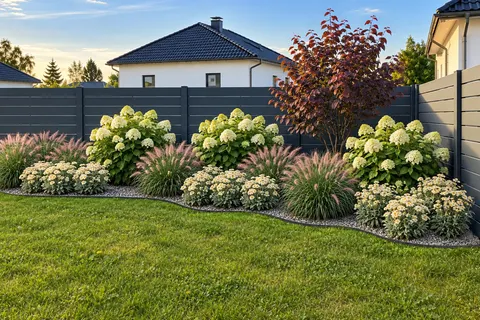
A garden is best planned in six steps: survey the site (light, soil, water, winter), decide what you will use it for, set the framework that still shows in winter, then lay out the border in layers, tall at the back and low at the front. Choose plants so that something flowers from spring to autumn, and finally work out the number of plants and the cost from the planting distances. Our garden planner works by the same rules.
 Fast-growing hedges: how much each grows in a year
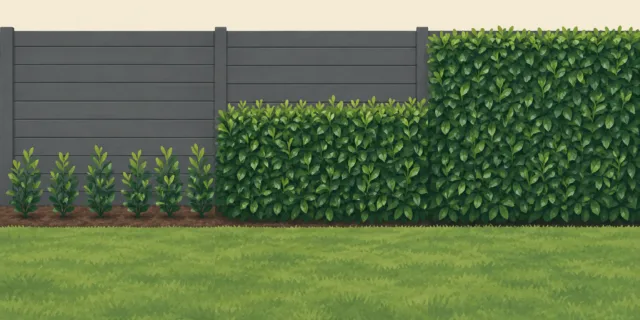
The fastest screening hedge plant is Leyland cypress, at about 60 cm a year, but it needs clipping two or three times a year and copes badly with drought. Cherry laurel 'Novita' and privet follow at about 40 cm a year, established Fargesia bamboos at 40-45 cm. In a natural, mixed hedge, elder and the thorny, suckering blackthorn grow fast too. How long it takes to reach a 180 cm screen depends more on the size of plant you buy: several years from small plants, one or two summers from large ones, but at many times the price per metre. The tables use the current shop prices in your country.
 Ground cover plants against weeds: which goes where, and how many you need
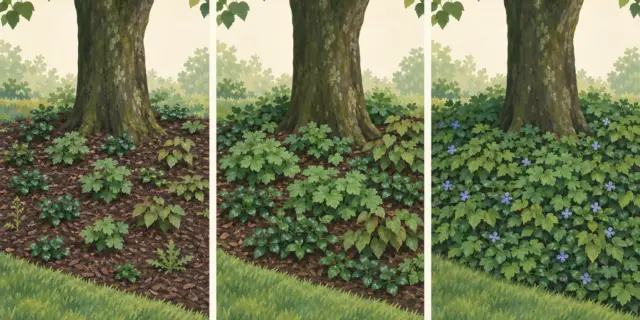
A ground cover keeps weeds out once it has closed up: until then, usually for two or three summers, it needs mulch and weeding. Under trees and in shade, lesser periwinkle, bigroot geranium, barrenwort and barren strawberry do best; in sunny, dry places stonecrops, thymes and creeping junipers. Most perennial ground covers take 9-18 plants per square metre. The tables work out what a square metre costs at today's shop prices in your country.
 Planting a hedge: how many plants per metre, and what it costs
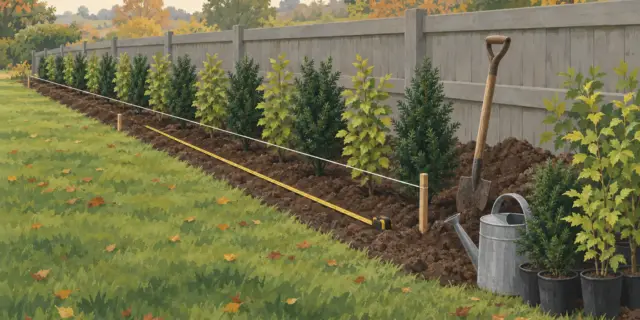
From plants 1-1.5 m tall, most hedges take 2.5-4 plants per metre: cherry laurel, photinia and yew 2.5 (40 cm apart), Leyland cypress and privet 3, hornbeam and beech 4; smaller plants take more. The plants go in one row, 80 cm from the fence, in autumn or early spring. What the hedge costs depends most on the size of the plants: the table works it out at today's shop prices in your country, for the length of your own hedge.
 Building a rock garden: stone, soil and plants step by step
A rock garden belongs on a sunny, gentle slope, in lean, free-draining soil: one third garden soil, one third coarse sand, one third crushed stone. Lay the stones, all of one kind, in layers leaning the same way and sunk a third to a half into the ground, so that about two fifths of the surface is stone. Four to six plants per square metre are enough: creeping junipers and grasses make the frame, and between them cushion perennials, stonecrops and thymes flower from March to October.
 A perennial border that flowers all summer: plants, layout, numbers
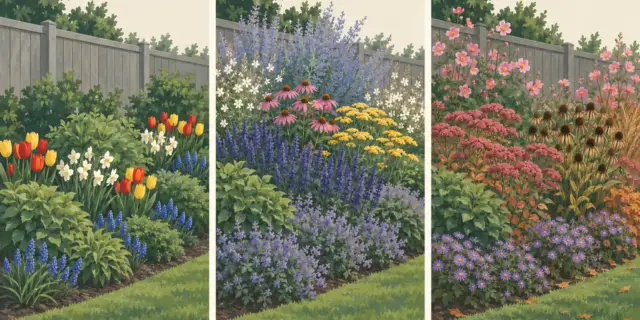
A perennial border flowers from spring to autumn when its backbone is long-flowering perennials that bloom from June to September (catmint, woodland sage, coneflower, yarrow, Russian sage, gaura), with bulbs around them for spring and Japanese anemone, sedum and asters for autumn. Plant in groups of 3-7, tall at the back, low at the front; on average you need 5-7 plants per square metre. The calendars show the hardy perennials for a sunny spot that shops in your country sell most widely, with the price per plant.
 Planting and pruning hydrangeas: which to cut back when
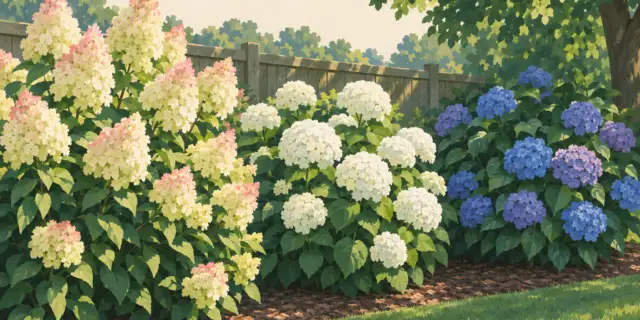
For pruning, hydrangeas fall into two groups. Panicle and smooth hydrangeas (such as 'Annabelle') flower on this year's shoots: cut them back to 25-60 cm in February or March. Bigleaf and mountain hydrangeas flower from buds that grew last year: in spring take off only the faded flowers, or they will not flower that year. Plant in autumn or spring, with plenty of water; for limy soil choose panicle or smooth hydrangea, as bigleaf hydrangea wants acid or neutral soil and afternoon shade.
 Planting tulips, daffodils and crocuses: when, how deep, how many
Spring-flowering bulbs go in in autumn: daffodils, crocuses and hyacinths from September to October, tulips from October to November, until the ground freezes. A bulb goes two to three times its own height deep (tulips and daffodils about 12-15 cm, crocuses 8-10 cm), tip up, at least twice its width from the next. Between perennials, 20 small, 8 medium and 4 large bulbs per square metre are enough. After flowering, leave their leaves on for six weeks.
 Planting and pruning lavender: when, where, how much to cut
Lavender wants a sunny spot and loose, free-draining soil, and likes limy soil too; plant it in spring, in April or May, 30-45 cm apart for a hedge. Prune it twice a year: in spring, in late March or April once hard frosts are over, cut the shoots back by about two thirds, but always only into green, leafy growth; after flowering, in late July or August, take off the faded flower stalks with the top 2-3 centimetres of leaves, shaping a dome. Never cut into the bare, woody part, as lavender does not regrow from it. English lavender and 'Hidcote' survive hard winters, lavandin is a little more tender, and French lavender takes only mild winters.
 Front garden: what to plant in front of the house, and how to plan it
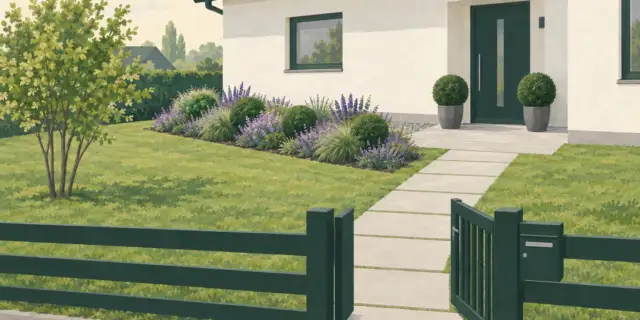
A front garden shows all year from the street and the door, so its frame matters most: at least a third of the planted area should be evergreen or attractive in winter, with long-flowering perennials and spring bulbs between. Leave a 40 cm gravel strip along the house wall, plant at least 50 cm from the wall, and a tree at least 3 metres from it. The aspect decides the plants: drought-tolerant ones for a south or west-facing front garden, shade-tolerant ones for a north-facing one.
 Trimming hedges and pruning cherry laurel: when, how often, with what
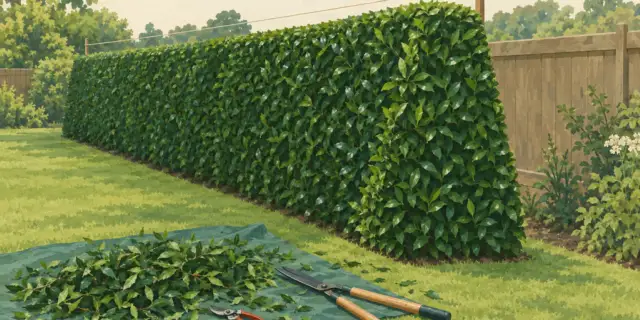
A clipped hedge usually needs trimming twice a year: in late May or June, after the first flush of growth, and in August; fast-growing privet and Leyland cypress even three times. Stop at the end of August so the new growth ripens before winter (yew can be clipped into September). Cut cherry laurel and other large-leaved hedges with secateurs, as a hedge trimmer slices the leaves. Trim the hedge narrower at the top, and if you see a nest in it, wait until the young have flown. Never cut cypress-family hedges back to the brown, leafless part, as they do not regrow from it.
 Ornamental grasses: which goes where, and when to cut them back
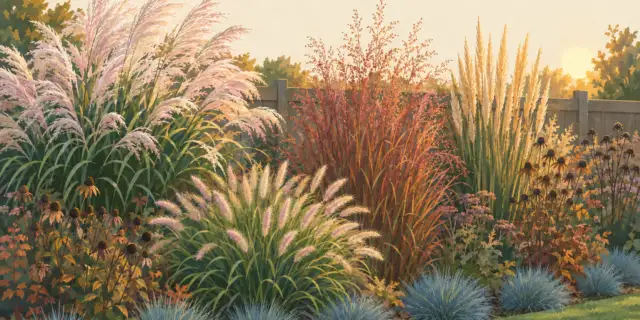
Tall grasses (Chinese silver grass, switchgrass, feather reed grass) belong in sun, at the back of a border or standing alone; low ones (blue fescue, sedges, 'Hameln' fountain grass) at the edge and in rock gardens; sedges and Japanese forest grass in shade. Leave deciduous grasses standing in winter and cut them back to 10-20 cm in February or March, before they shoot; do not cut evergreen or semi-evergreen grasses back, only comb out the dead leaves in spring. Plant warmth-loving grasses (silver grass, fountain grass, switchgrass) in spring.
 Evergreen shrubs for a small garden: how big each gets in ten years
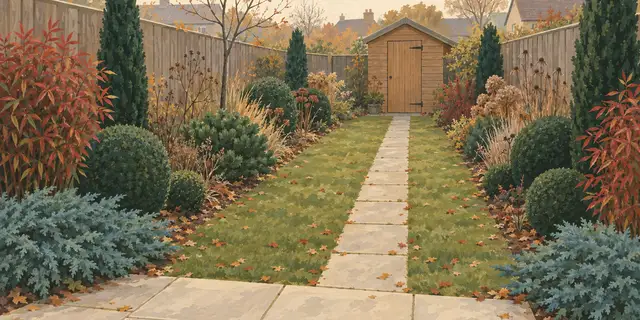
A small garden needs evergreen shrubs that grow no bigger than 2 metres in ten years, or ones you clip every year. For low ones, mountain pine; for medium ones, blue holly, Oregon grape and wintergreen barberry; for a narrow column, the Irish yew. Instead of thuja and box, yew is the safest choice, and on acid or neutral soil Japanese holly too. The tables show the hardy evergreens sold in your country, with their ten-year size and today's price.