Building a rock garden: stone, soil and plants step by step
A rock garden belongs on a sunny, gentle slope, in lean, free-draining soil: one third garden soil, one third coarse sand, one third crushed stone. Lay the stones, all of one kind, in layers leaning the same way and sunk a third to a half into the ground, so that about two fifths of the surface is stone. Four to six plants per square metre are enough: creeping junipers and grasses make the frame, and between them cushion perennials, stonecrops and thymes flower from March to October.
Updated: October 24, 2026 · Data and prices from our plant database, worked out for your country. How our data is made

Where should the rock garden go?
Most rock garden plants come from sunny, stony mountain places: they want at least six hours of sun a day, and their soil never stands in water. The best spot is a gentle slope or bank facing south or west, from which water runs off by itself. Do not build it under trees: they give shade, and cushion plants rot under the fallen leaves.
A flat garden can have a rock garden too: build an irregular mound 40-60 cm high, with the steeper side at the back. A rock garden against the house wall or at the foot of a fence works as well if it is sunny, but there the stones should lean against the wall, not soil heaped against it.
Step by step
- Mark out the spot and dig out perennial weeds with their roots (couch grass, field bindweed, creeping thistle). Later they are almost impossible to get out from between the stones, so this is the most important step.
- On heavy clay, take out the top 20-30 cm and put 15-20 cm of rubble or gravel at the bottom so the water drains away. Loose, sandy soil does not need this.
- Mix the soil: one third garden soil, one third coarse sand, one third crushed stone or fine gravel. Add no manure and little compost: a rock garden plant stays compact in lean soil and gets leggy and falls apart in rich soil.
- Lay the stones from the bottom up. Sink the larger ones a third to a half into the ground, lying on their broad side, not standing on edge, and all leaning the same way, like a natural outcrop. Firm the soil under each stone so it does not rock. About two fifths of the surface should be stone; leave planting pockets between the stones.
- Let the soil settle for two or three weeks and water it a few times meanwhile. Top up where it has sunk before you plant.
- After planting, cover the surface with 3-5 cm of fine gravel or crushed stone. It holds weeds back and keeps the base of the plants dry. Do not put weed fabric under the plants: cushion perennials cannot spread on it, and in time it shows through the gravel.
What stone do you need?
Use one kind of stone, ideally quarried nearby: it is cheaper, as it travels less, and it makes the garden look more natural. Mixed stone of many colours looks contrived. A few large stones are worth more than many small ones: stones of 30-60 cm give the rock garden its structure, small ones are only for the gaps.
Limestone and dolomite slowly make the soil limy. Most rock garden plants (aubretia, pasque flower, pinks, houseleeks) like that; those that want acid soil (heath, heather) do not, and go with andesite, basalt or granite.
Plants: the frame and the flowers
A rock garden needs a frame that shows in winter too: one or two creeping junipers or cotoneasters and a few clumps of grass. Put them among the stones in the upper part of the rock garden, not in a row in the middle.
 Bearberry cotoneaster
 Blue fescue
 Carpet cotoneaster
 Creeping juniper
 Black mondo grass
 Bearskin fescue
 Crocus
8–15 cm
€4.60


 Moss phlox
10–15 cm
€4.70
 Aubrieta
5–15 cm
€4.70


 Alpine aster
15–40 cm
€4.70
 Common thyme
15–30 cm
€8.90

 Sea thrift
15–30 cm
€7.20


 Lemon thyme
15–30 cm
€5.40


The calendar shows the plants for a sunny rock garden that shops sell most widely: up to 50 cm tall, drought-tolerant, and hardy in an average winter. Pick two or three for each month, and the rock garden flowers from March to October. Spring cushions (aubretia, phlox, rock cress) go above the stones where they can hang over; stonecrops and thymes on the flatter parts between them. The price is the typical price of a plant of the usual size in your country.
You find all rock garden plants in the rock garden plants list, and the long-flowering ones in perennials that flower all summer.
Planting and care
- Plant sparsely: four to six plants per square metre are enough, and the stone and gravel should show between them. A 2 × 3 m rock garden thus takes 25-35 plants.
- Set each plant next to a stone, slightly higher than its surroundings, and cover its neck with gravel. Under the stone the roots stay cool and moist, and the neck does not rot.
- Water regularly only in the first summer, after that only in a long drought. No feeding is needed.
- Cut spring cushion plants (aubretia, moss phlox, rock cress, candytuft) back by a third after flowering: they stay compact and do not go bare in the middle.
- In autumn, pick fallen leaves off the cushions. It is not the cold that kills rock garden plants, it is winter wet.
For a small space: wall, steps, stone trough
- A dry-laid (mortarless) retaining wall: plant houseleeks, stonecrops, rock cress and aubretia into the soil between the stones while you build. In a few years the wall becomes a flowering vertical rock garden.
- The edge of steps and the joints of paving: low cushions that take some treading belong there, such as wild thyme and Irish moss.
- A stone trough, an old water trough, a large shallow pot: give it a drainage hole, fill it with the mix above, and plant houseleeks, stonecrops and a small grass. On a terrace or by the door, this is the smallest rock garden.
A plan for your own garden
Our garden planner's Rock garden style works by the same rules: it picks only plants up to 40 cm that are known to bear drought, draws in the stones and gravel too (two fifths of the surface is stone), and sets the plants openly, at 1.3 times their own spacing, so the stone shows. On the picture drawn onto your photo it also shows how it looks in the 1st, 3rd and 5th summer.
More guides
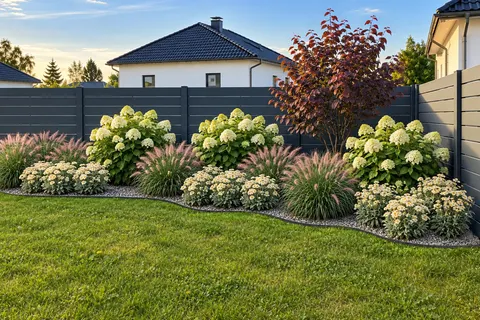 How to plan a garden, step by step
A garden is best planned in six steps: survey the site (light, soil, water, winter), decide what you will use it for, set the framework that still shows in winter, then lay out the border in layers, tall at the back and low at the front. Choose plants so that something flowers from spring to autumn, and finally work out the number of plants and the cost from the planting distances. Our garden planner works by the same rules.
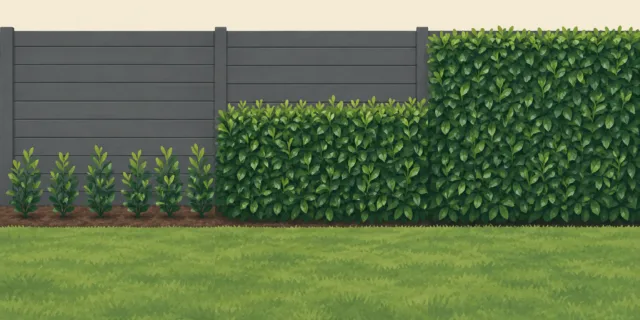 Fast-growing hedges: how much each grows in a year
The fastest hedge plant is the Leyland cypress, growing about 90 cm a year, followed by cherry laurel 'Novita', firethorn and western red cedar at about 50 cm a year, then privet at 40 cm. How long a 180 cm hedge takes to screen depends more on the size of plant you buy: several years from small plants, one or two summers from large ones, but at many times the price per metre. The tables use the current shop prices in your country.
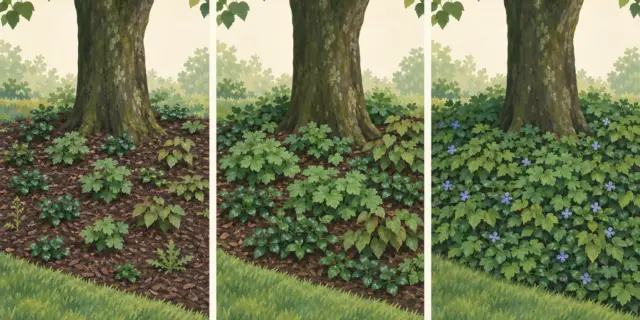 Ground cover plants against weeds: which goes where, and how many you need
A ground cover keeps weeds out once it has closed up: until then, usually for two or three summers, it needs mulch and weeding. Under trees and in shade, lesser periwinkle, bigroot geranium, barrenwort, barren strawberry and Japanese spurge do best; in sunny, dry places stonecrops, thymes and creeping junipers. Most perennial ground covers take 9-18 plants per square metre. The tables work out what a square metre costs at today's shop prices in your country.
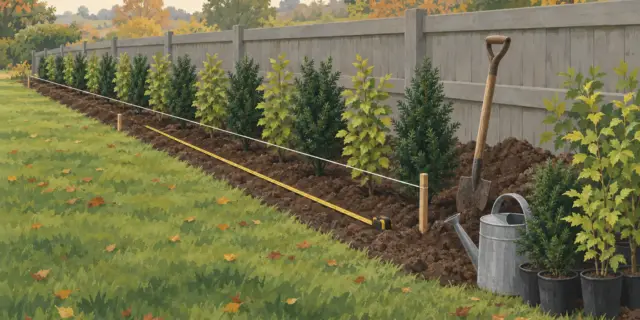 Planting a hedge: how many plants per metre, and what it costs
Most hedge plants go in at 2-4 plants per metre: Leyland cypress 2, cherry laurel and photinia 2.5 (40 cm apart), yew 3, hornbeam 3.5, privet and beech 4. The plants go in one row, 80 cm from the fence, in autumn or early spring. What the hedge costs depends most on the size of the plants: the table works it out at today's shop prices in your country, for the length of your own hedge.
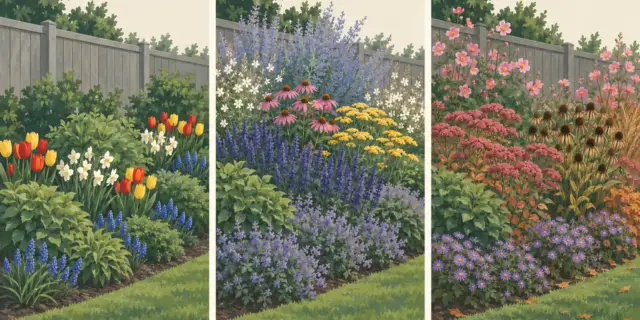 A perennial border that flowers all summer: plants, layout, numbers
A perennial border flowers from spring to autumn when its backbone is long-flowering perennials that bloom from June to September (catmint, woodland sage, coneflower, yarrow, Russian sage, gaura), with bulbs around them for spring and Japanese anemone, sedum and asters for autumn. Plant in groups of 3-7, tall at the back, low at the front; on average you need 5-7 plants per square metre. The calendars show the hardy perennials for a sunny spot that shops in your country sell most widely, with the price per plant.