A garden on a budget: where to save on plants
In a garden, most of what plants cost goes on the size of shrubs, trees and hedges: the same plant in a large size can cost two or three times as much as a small one, and for trees and large evergreens even ten or twenty times as much. You save most with smaller plants, bare-root hedges and trees, sparser planting and dividing; a fast-growing perennial from a small pot catches up with a large one in a year. The table shows how much cheaper the small size is at today's shop prices in your country.
Updated: November 17, 2026 · Prices checked: November 23, 2026 · Data and prices from our plant database, worked out for your country. How our data is made

Where does the money go?
The perennials of a bed are rarely a large item: a small potted perennial usually costs about 1500-3000 HUF. The cost comes from woody plants, because they are sold by size, and the price of a larger plant grows not in proportion but many times over. With a hedge the length comes on top: a 20-metre hedge means 50-100 plants.
Paving, earthworks and fencing can cost more still; this guide is about plants only. Our garden planner's price is for plants too: the plan works out what they cost at today's shop prices in your country before you buy anything.
A smaller plant, the same plant
Size is where you save most. Shops sell the plants below in several sizes; the table compares the cheapest price of the smallest and the largest size.

- Small plant
- 15 cm: €29
- Large plant
- 100 cm: €300
- The large one costs
- 10×

- Small plant
- 25 cm: €11
- Large plant
- 175 cm: €190
- The large one costs
- 18×

- Small plant
- 30 cm: €8.20
- Large plant
- 175 cm: €320
- The large one costs
- 39×

- Small plant
- 25 cm: €18
- Large plant
- 175 cm: €160
- The large one costs
- 9.2×

- Small plant
- 20 cm: €6.20
- Large plant
- 200 cm: €370
- The large one costs
- 60×

- Small plant
- 15 cm: €7.80
- Large plant
- 100 cm: €90
- The large one costs
- 12×

- Small plant
- 30 cm: €15
- Large plant
- 150 cm: €320
- The large one costs
- 21×

- Small plant
- 10 cm: €4.30
- Large plant
- 190 cm: €330
- The large one costs
- 77×

- Small plant
- 10 cm: €4
- Large plant
- 60 cm: €39
- The large one costs
- 9.6×

- Small plant
- 20 cm: €8.30
- Large plant
- 125 cm: €35
- The large one costs
- 4.2×

- Small plant
- 30 cm: €12
- Large plant
- 175 cm: €76
- The large one costs
- 6.2×

- Small plant
- 9 cm: €6.80
- Large plant
- 175 cm: €64
- The large one costs
- 9.4×
|
Plant
|
Small plant
|
Large plant
|
The large one costs
|
|---|---|---|---|
|
Rhododendron
Evergreen
|
15 cm: €29 | 100 cm: €300 | 10× |
|
Japanese maple
Deciduous
|
25 cm: €11 | 175 cm: €190 | 18× |
|
Common lilac
Deciduous
|
30 cm: €8.20 | 175 cm: €320 | 39× |
|
Saucer magnolia
Deciduous
|
25 cm: €18 | 175 cm: €160 | 9.2× |
|
Common yew
Evergreen
|
20 cm: €6.20 | 200 cm: €370 | 60× |
|
Panicle hydrangea
Deciduous
|
15 cm: €7.80 | 100 cm: €90 | 12× |
|
Rose of Sharon
Deciduous
|
30 cm: €15 | 150 cm: €320 | 21× |
|
Cherry laurel
Evergreen
|
10 cm: €4.30 | 190 cm: €330 | 77× |
|
Japanese spindle
Evergreen
|
10 cm: €4 | 60 cm: €39 | 9.6× |
|
Weigela
Deciduous
|
20 cm: €8.30 | 125 cm: €35 | 4.2× |
|
Common hazel
Deciduous
|
30 cm: €12 | 175 cm: €76 | 6.2× |
|
Mock orange
Deciduous
|
9 cm: €6.80 | 175 cm: €64 | 9.4× |
A small plant is not only cheaper, it also establishes more easily and adapts to its place sooner. How long it takes to grow depends on the plant: once established, yew grows about 15-25 cm a year, so a 20 cm plant is 1.2 m tall in roughly six to eight years (for a hedge buy the plain species: dwarf and spreading cultivars stay low); hornbeam about 30 cm, so a 60 cm plant reaches 3 metres in eight. A large plant is worth its price where you need cover or height at once: a focal tree, or a hedge in front of the neighbour's window.
Perennials in small pots
For fast-growing perennials (catmint, salvia, ornamental grasses), a plant sold in a small 9 cm pot is enough. Within a season it catches up with one from a larger pot, and it needs no large hole. Slow growers (peony, hellebore, hosta) are worth buying bigger. A large potted perennial is worth it only if the bed must look full in its first summer.
Plant in autumn: a perennial roots in before winter and needs less watering the next summer. The guide to a perennial border that flowers all summer covers long-flowering perennials and how many you need.
Bare-root hedges and trees
Nurseries also sell deciduous hedge plants (hornbeam, beech, privet, hawthorn) and fruit trees bare-root, without soil, from November to March, often in bundles; plant them when the ground is neither frozen nor waterlogged. It is the cheapest way to a long hedge: online shops rarely sell them, so the table does not show them; look in a local nursery.
Plant bare-root plants soon after buying; their roots must not dry out. How many plants a metre takes and how to plant them is in the hedge planting guide.
Plant further apart
- The number comes from the planting distance. In a bed, plant one and a half times as far apart and you need fewer than half the plants (in a hedge row, two thirds), but they close up a year or two later. Meanwhile cover the soil between them with 5-7 cm of mulch, and weed.
- In step 4 of our garden planner you can choose how full the bed should be: an airy plan uses fewer plants, a full plan more, closing up by the third summer.
- Fill large empty patches with ground cover, not many small perennials; fast-spreading ground covers cover the soil even when planted sparsely. The guide to ground covers shows which goes where.
Propagate your own
- Division: most perennials and grasses can be divided after three or four years. Dig up summer-flowering perennials in spring or autumn, spring-flowering ones after flowering and grasses only in spring, split them with a spade, and one plant makes three or four. Peonies and hellebores dislike being divided. If a neighbour divides theirs, ask for some.
- Annuals and perennials from seed: marigolds, cosmos, coneflowers and woodland sage can be raised from seed, and many self-seeders (Verbena bonariensis, for one) spread in the garden on their own.
- Spring bulbs are the cheapest spring colour: 4-20 bulbs per square metre among perennials (fewer of the large ones, more of the small), and daffodils, crocuses and grape hyacinths spread year after year. The bulb guide says when and how to plant them.
Few kinds, many plants
A cheap garden is not about few plants but about few kinds. 6-9 kinds are enough for a bed, in drifts and repeated: calmer and tidier than many different plants bought one by one, and buying several of the same kind in a small size is easier.
Before you buy, check with our garden planner what suits your spot and what it costs: the plan lists the numbers and today's shop prices, so you buy nothing you do not need, and nothing that would not survive in your spot.
Sources
The advice rests on these expert pages and laws, adapted to Central European winters and soils. The tables come from our own plant database.
- Bayerische Gartenakademie: Die ideale Pflanzzeit für Gehölze und Stauden
- Natur im Garten: Bäume für den Hausgarten
- RHS: Perennials: dividing
More guides
 How to plan a garden, step by step
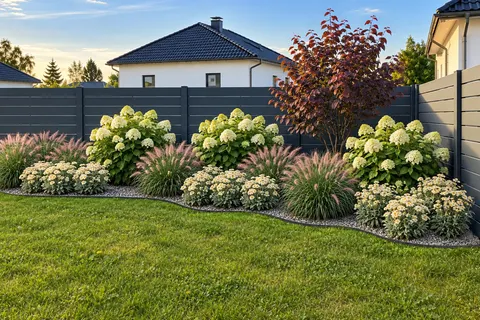
A garden is best planned in six steps: survey the site (light, soil, water, winter), decide what you will use it for, set the framework that still shows in winter, then lay out the border in layers, tall at the back and low at the front. Choose plants so that something flowers from spring to autumn, and finally work out the number of plants and the cost from the planting distances. Our garden planner works by the same rules.
 Fast-growing hedges: how much each grows in a year
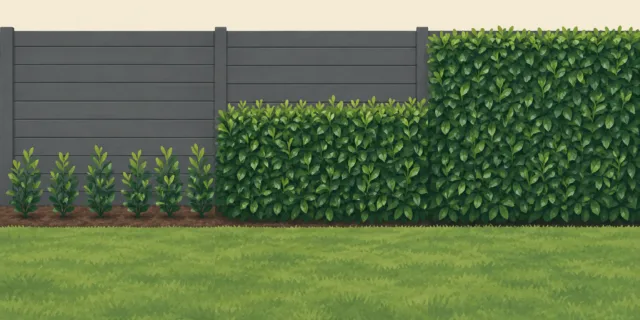
The fastest screening hedge plant is Leyland cypress, at about 60 cm a year, but it needs clipping two or three times a year and copes badly with drought. Cherry laurel 'Novita' and privet follow at about 40 cm a year, established Fargesia bamboos at 40-45 cm. In a natural, mixed hedge, elder and the thorny, suckering blackthorn grow fast too. How long it takes to reach a 180 cm screen depends more on the size of plant you buy: several years from small plants, one or two summers from large ones, but at many times the price per metre. The tables use the current shop prices in your country.
 Ground cover plants against weeds: which goes where, and how many you need
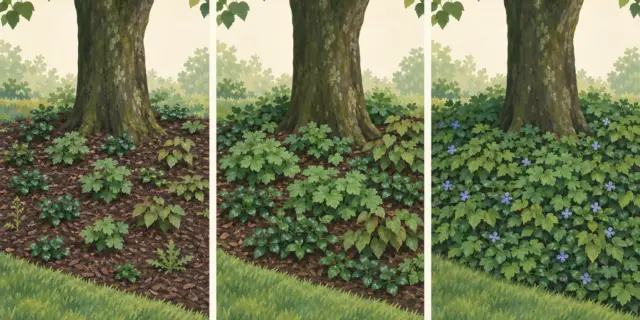
A ground cover keeps weeds out once it has closed up: until then, usually for two or three summers, it needs mulch and weeding. Under trees and in shade, lesser periwinkle, bigroot geranium, barrenwort and barren strawberry do best; in sunny, dry places stonecrops, thymes and creeping junipers. Most perennial ground covers take 9-18 plants per square metre. The tables work out what a square metre costs at today's shop prices in your country.
 Planting a hedge: how many plants per metre, and what it costs
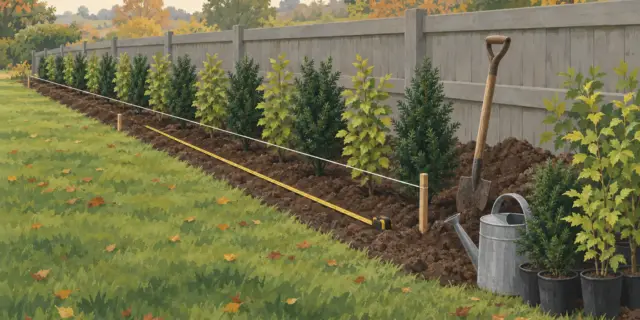
From plants 1-1.5 m tall, most hedges take 2.5-4 plants per metre: cherry laurel, photinia and yew 2.5 (40 cm apart), Leyland cypress and privet 3, hornbeam and beech 4; smaller plants take more. The plants go in one row, 80 cm from the fence, in autumn or early spring. What the hedge costs depends most on the size of the plants: the table works it out at today's shop prices in your country, for the length of your own hedge.
 Building a rock garden: stone, soil and plants step by step
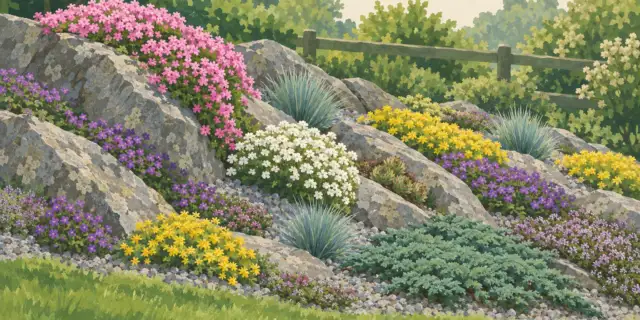
A rock garden belongs on a sunny, gentle slope, in lean, free-draining soil: one third garden soil, one third coarse sand, one third crushed stone. Lay the stones, all of one kind, in layers leaning the same way and sunk a third to a half into the ground, so that about two fifths of the surface is stone. Four to six plants per square metre are enough: creeping junipers and grasses make the frame, and between them cushion perennials, stonecrops and thymes flower from March to October.
 A perennial border that flowers all summer: plants, layout, numbers
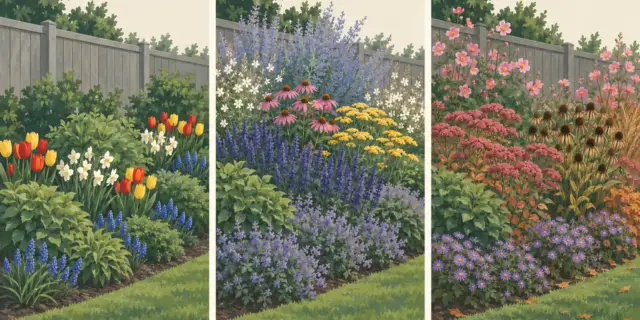
A perennial border flowers from spring to autumn when its backbone is long-flowering perennials that bloom from June to September (catmint, woodland sage, coneflower, yarrow, Russian sage, gaura), with bulbs around them for spring and Japanese anemone, sedum and asters for autumn. Plant in groups of 3-7, tall at the back, low at the front; on average you need 5-7 plants per square metre. The calendars show the hardy perennials for a sunny spot that shops in your country sell most widely, with the price per plant.
 Planting and pruning hydrangeas: which to cut back when
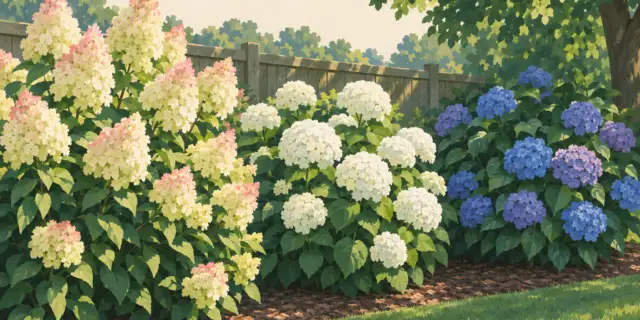
For pruning, hydrangeas fall into two groups. Panicle and smooth hydrangeas (such as 'Annabelle') flower on this year's shoots: cut them back to 25-60 cm in February or March. Bigleaf and mountain hydrangeas flower from buds that grew last year: in spring take off only the faded flowers, or they will not flower that year. Plant in autumn or spring, with plenty of water; for limy soil choose panicle or smooth hydrangea, as bigleaf hydrangea wants acid or neutral soil and afternoon shade.
 Planting tulips, daffodils and crocuses: when, how deep, how many
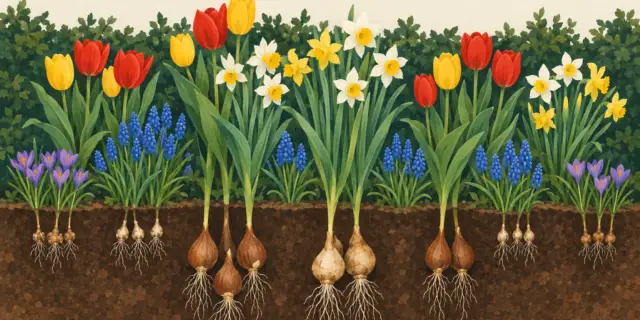
Spring-flowering bulbs go in in autumn: daffodils, crocuses and hyacinths from September to October, tulips from October to November, until the ground freezes. A bulb goes two to three times its own height deep (tulips and daffodils about 12-15 cm, crocuses 8-10 cm), tip up, at least twice its width from the next. Between perennials, 20 small, 8 medium and 4 large bulbs per square metre are enough. After flowering, leave their leaves on for six weeks.
 Planting and pruning lavender: when, where, how much to cut
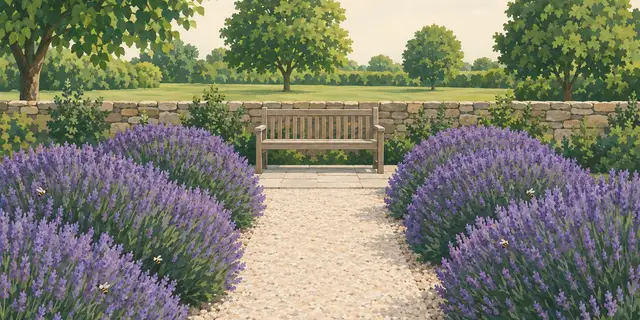
Lavender wants a sunny spot and loose, free-draining soil, and likes limy soil too; plant it in spring, in April or May, 30-45 cm apart for a hedge. Prune it twice a year: in spring, in late March or April once hard frosts are over, cut the shoots back by about two thirds, but always only into green, leafy growth; after flowering, in late July or August, take off the faded flower stalks with the top 2-3 centimetres of leaves, shaping a dome. Never cut into the bare, woody part, as lavender rarely regrows from it. English lavender and 'Hidcote' survive hard winters, lavandin is a little more tender, and French lavender takes only mild winters.
 Front garden: what to plant in front of the house, and how to plan it
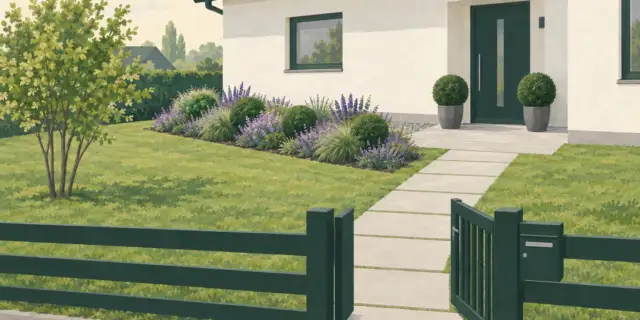
A front garden shows all year from the street and the door, so its frame matters most: at least a third of the planted area should be evergreen or attractive in winter, with long-flowering perennials and spring bulbs between. Leave a 40 cm gravel strip along the house wall, plant at least 50 cm from the wall, and a tree at least 3 metres from it. The aspect decides the plants: drought-tolerant ones for a south or west-facing front garden, shade-tolerant ones for a north-facing one.
 Trimming hedges and pruning cherry laurel: when, how often, with what
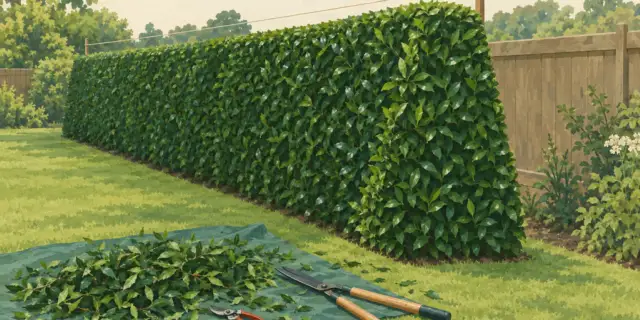
A clipped hedge usually needs trimming twice a year: in late May or June, after the first flush of growth, and in August; fast-growing privet and Leyland cypress even three times. Stop at the end of August so the new growth ripens before winter (yew can be clipped into September). Cut cherry laurel and other large-leaved hedges with secateurs, as a hedge trimmer slices the leaves. Trim the hedge narrower at the top, and if you see a nest in it, wait until the young have flown. Never cut cypress-family hedges back to the brown, leafless part, as they do not regrow from it.
 Ornamental grasses: which goes where, and when to cut them back
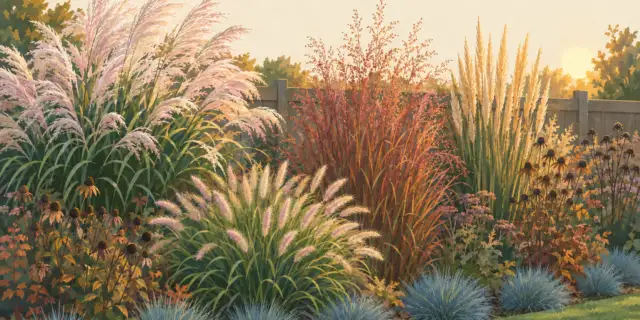
Tall grasses (Chinese silver grass, switchgrass, feather reed grass) belong in sun, at the back of a border or standing alone; low ones (blue fescue, sedges, 'Hameln' fountain grass) at the edge and in rock gardens; sedges and Japanese forest grass in shade. Leave deciduous grasses standing in winter and cut them back to 10-20 cm in February or March, before they shoot; do not cut evergreen or semi-evergreen grasses back, only comb out the dead leaves in spring. Plant warmth-loving grasses (silver grass, fountain grass, switchgrass) in spring.
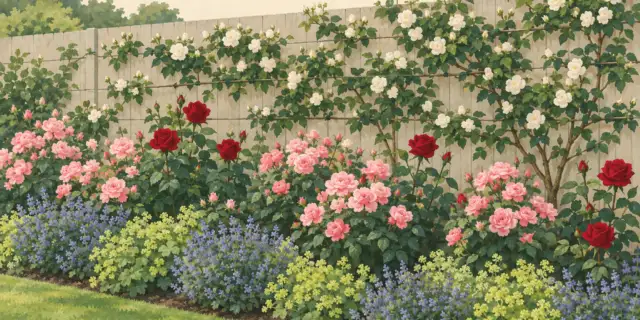 Pruning roses: which to cut back when, and how hard
Prune roses in spring, in March, as the buds begin to swell (the old rule says: when the forsythia flowers). Cut the strong stems of hybrid tea roses back to 10-15 cm, 4-6 buds, and those of floribundas to 25-30 cm; shrub and ground cover roses only lightly, by a third. Tie the main canes of a climbing rose horizontally and cut the flowered side shoots back by two thirds. Always cut at a slant, about 5 mm above an outward-facing bud.
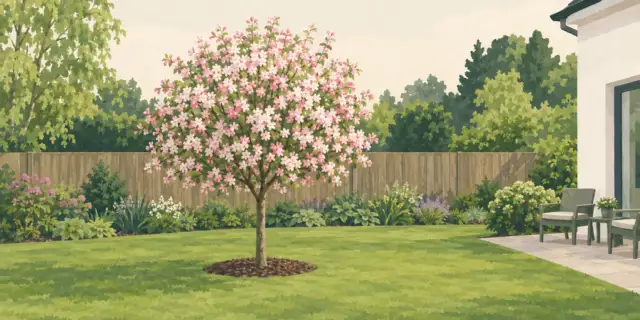 A small tree for the garden: how big each gets, and how far away to plant it
For a small garden choose a tree that will not grow over 6-8 metres even in the end: a crab apple, hawthorn, Japanese maple, magnolia, or a grafted globe-headed tree (globe maple, globe locust, dwarf catalpa). Plant the tree at least 2 metres from the fence (1.2 metres for one that stays under 3 metres), and at least half its ten-year crown width; at least 3 metres from the house, and on heavy clay half its final height. Plant it in autumn, and water it deeply once a week for the first two summers.
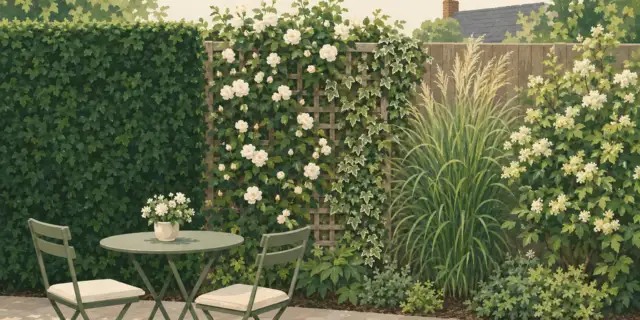 Privacy with plants: what to plant along the fence
What you screen with depends first on how much room there is in front of the fence. 30-50 cm calls for a climber on the fence or a trellis (only ivy and climbing wintercreeper screen in winter), 1.2-1.5 m for a clipped hedge, 1.5-2.5 m for a free-growing row of shrubs, a narrow spot for a columnar plant or tall grass. Only evergreens screen fully in winter. Often you do not need to screen the whole fence, only where people can see in: in front of the terrace and the windows.
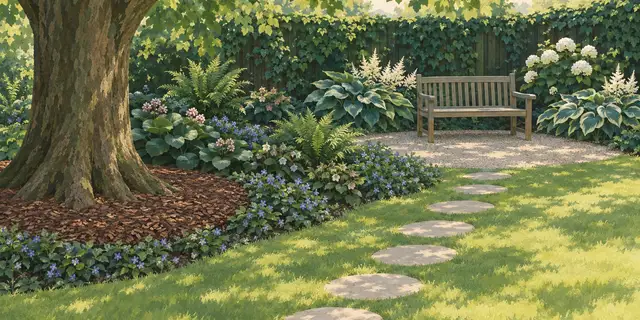 Shade-tolerant plants: what to plant in a shady garden
In a shady garden, first look at what kind of shade you have: how many hours of sun the spot gets, and whether the soil is dry. Under a large tree, in dry shade, plant lesser periwinkle, bergenia, hellebores, bigroot geranium and barrenwort; on the north side of the house, in moist soil, hostas, astilbes, Siberian bugloss and ferns. Among shrubs, yew, cherry laurel and hydrangea take shade. The tables show the plants for full shade sold in your country, at today's prices.
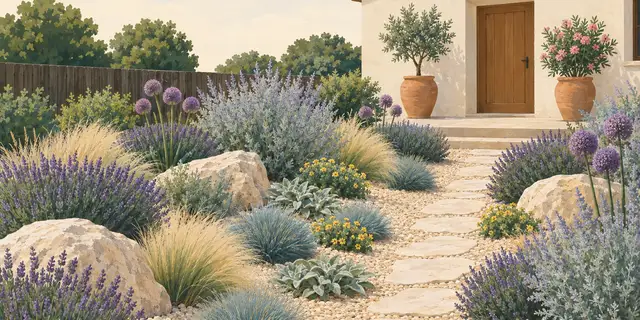 A Mediterranean garden without watering: a gravel bed with hardy plants
A Mediterranean-style garden here does not come from olive trees and oleanders, which do not survive an average winter outdoors, but from hardy plants of dry, sunny habitats: lavender, Russian sage, catmint, ornamental onions, irises, ornamental grasses, bluebeard and smoke bush. Planted in sun, in lean, free-draining soil under 5-7 cm of gravel, they live without watering after the first summer. The tables show the hardy plants sold in your country, and separately the ones that only last in a pot or in a sheltered spot in a mild region.
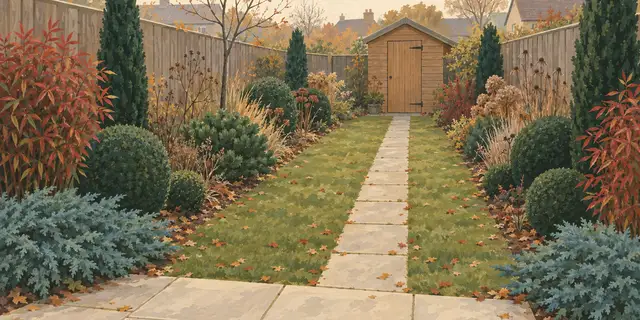 Evergreen shrubs for a small garden: how big each gets in ten years
A small garden needs evergreen shrubs that grow no bigger than 2 metres in ten years, or ones you clip every year. For low ones, mountain pine; for medium ones, blue holly, Oregon grape and wintergreen barberry; for a narrow column, the Irish yew. Instead of thuja and box, yew is the safest choice, and on acid or neutral soil Japanese holly too. The tables show the hardy evergreens sold in your country, with their ten-year size and today's price.