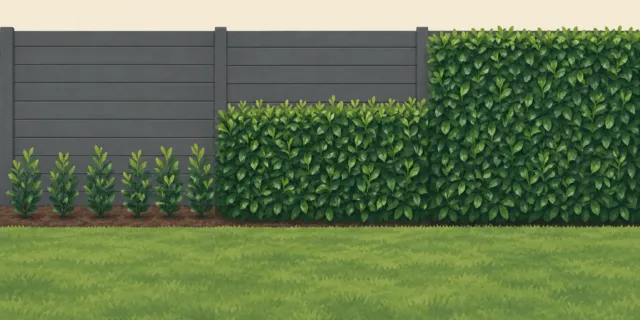
How to plan a garden, step by step
A garden is best planned in six steps: survey the site (light, soil, water, winter), decide what you will use it for, set the framework that still shows in winter, then lay out the border in layers, tall at the back and low at the front. Choose plants so that something flowers from spring to autumn, and finally work out the number of plants and the cost from the planting distances. Our garden planner works by the same rules.
Updated: October 16, 2026 · Data and prices from our plant database, worked out for your country. How our data is made
 The photo
 The plan in the 3rd summer
Survey the site
You choose the plant for the place, not the other way round. Before you pick anything, look at five things.
- Light: how many hours of direct sun the spot gets in summer. Over six hours is full sun, three to six is part shade, under three is shade. The north side of a building and the ground under dense trees are shade, and need shade-tolerant plants.
- Soil: sandy, clay or ordinary garden soil. Sand dries out fast and wants drought-tolerant plants. Water stands in heavy clay, so no plant that needs good drainage can go there, only one that copes with clay.
- Water: whether you will water. Without watering, only highly drought-tolerant plants can go in a sunny spot, and even they need watering for the first two years while their roots go down.
- Winter: the coldest winter temperature where you live. Our garden planner reckons with winters of -15 to -24 °C by region, one step colder in the mountains. Whatever bears less freezes.
- Size: the length and depth of the area to plant, and what stands behind it (fence, house wall) and in front of it (lawn, path). The depth decides how many layers fit: one under 80 cm, two under 150 cm, three above that.
Decide what you will use it for
How the garden is used narrows the plant list before taste even comes into it.
- If a dog, a cat or a small child uses the garden, only plants known to be non-toxic will do (the lists of plants non-toxic to dogs, cats and children), and nothing thorny next to a child. Toxicity is reliably known for fewer plants, so these lists are shorter.
- If you need screening from the neighbours, a hedge or screening plants go in the back row. How long it takes to screen is worked out in the guide to fast-growing hedges.
- If you have little time for care, choose low-maintenance perennials and shrubs, and cover the soil so weeds do not grow.
- If you would like bees and butterflies, choose from pollinator-friendly perennials and shrubs.
The framework: what still shows in winter
The framework is the skeleton of the garden: a hedge, a small tree, evergreen shrubs, clipped balls, tall ornamental grasses. In summer they stand behind the flowers; in winter they are all that is left. Our garden planner accepts a plan only if at least a third of the planted area is evergreen or ornamental in winter.
A small tree gives a border its high point. Do not put it in the middle but a third of the way along, and leave room in front of it for a lower group. In a small garden choose a small ornamental tree, and next to a path or paving one whose roots will not lift the paving.
The rest of the framework comes from clipped balls and evergreen plants. A single ball gets lost: it works in a group of three, or repeated in a rhythm along the border.
The border: tall at the back, low at the front
A good border is built in layers. Tall plants stand at the back, in front of the fence or wall, medium ones in the middle, low ones at the front, so each can be seen. The layers should not meet in a straight line: let the groups run at an angle, slipping into one another a little.
Plant few varieties, in large drifts. Allow roughly 2-3 square metres per variety; 4-6 varieties are enough for a smaller border. Plant perennials in groups of 3-7 and shrubs singly or in threes. No variety should take up half the area, or the border becomes monotonous, and if that one falls ill, the whole border is bare.
The gaps between the groups are filled by a low ground cover or grass, from the fence to the edge. This is the matrix: it makes a continuous carpet and leaves no room for weeds. German mixed perennial plantings and Piet Oudolf's borders are built the same way, with much of the area in such low plants. Choose from the ground cover plants.
- The tallest plant should reach roughly twice the depth of the border. Reckon with the size after ten years, not the size of the plant you buy.
- Put no block taller than 60 cm in the front 40 centimetres of the border. Airy, see-through plants (ornamental onion, verbena) are the exception: you can look through them.
- Put plants with similar water needs side by side: lavender and hydrangea cannot thrive in the same soil.
Something to look at all year
A garden is good when it is not only beautiful in June. Check three things on the plant list.
- Something should flower in every month from April to September. Bulbs fill early spring (crocus, daffodil, tulip), and perennials that flower all summer fill the summer.
- In autumn, at least one plant should have autumn colour or late flowers.
- In winter, a framework should remain: evergreens, ornamental grasses that stand through winter, ornamental bark or fruit. This is the third mentioned under the framework.
How many plants, and what does it cost?
The number of plants comes from the planting distance, not from a guess. Every plant has a recommended planting distance, roughly the room it fills when grown, and plants are set in a triangular pattern, that is in staggered rows. A perennial planted 40 cm apart thus needs about 7 plants per square metre, one planted 60 cm apart about 3.
Most of the cost comes from the size of the shrubs and trees: the larger plant of the same kind sells at several times the price. A small potted perennial catches up with a large one in a year or two; a shrub or hedge plant does not.
Plant list of the example garden on our home page
-
 Eastern redbud
1 pcs
Eastern redbud
1 pcs
-
 Smooth hydrangea
3 pcs
Smooth hydrangea
3 pcs
-
 Oriental fountain grass
10 pcs
Oriental fountain grass
10 pcs
-
 Pearly everlasting
14 pcs
Pearly everlasting
14 pcs
The full garden plan costs HUF 9,990: three versions, a plant list with numbers and prices, a planting scheme and pictures of the summer of the 1st, 3rd and 5th year.
The price is the current, rounded shop price of the example garden's plants in your country, as our plan lists them. Soil improvement, mulch or gravel and any watering system come on top of the plants.
A plan from a photo, by the same rules
Our garden planner does these steps from a photo and a few questions: it filters plants that suit your site from a checked database, arranges them in layers, works out the number of plants and the cost, and shows how the garden looks in the summer of the 1st, 3rd and 5th year. The preview is free.
The plan does not replace a gardener's advice on site: the soil, the pipes and cables, and the shade of the neighbours' trees have to be checked on the spot.
 Year 1
 Year 3
 Year 5