Hedge plants that stay at 1.5 metres or lower as a hedge: for edging a border, a front garden or dividing parts of the garden.
10 plants from our verified database, by name. A plant is only listed when the data this list relies on is not in doubt. How our data is made

Symphoricarpos × doorenbosii 1.5 m × 1.8 m after 10 years
This hybrid snowberry is an almost indestructible, dense shrub with arching branches: its tiny, inconspicuous flowers are popular with bees and are…

Lavandula angustifolia 'Hidcote' 60 cm × 50 cm after 10 years
'Hidcote' forms a compact mound of silvery foliage topped with fragrant, dark-purple flowers that attract bees. It works well along sunny borders,…

Chaenomeles × superba 1.2 m × 1.5 m after 10 years
A low, spreading, thorny deciduous shrub that covers itself in large, waxy, mostly red flowers in early spring before the leaves, when little else…

Santolina rosmarinifolia 60 cm × 80 cm after 10 years
A Mediterranean subshrub with bright green, thread-fine aromatic foliage that forms a dense cushion and is covered with pale yellow button flowers…

Hyssopus officinalis 60 cm × 45 cm after 10 years
A low, aromatic, woody-based subshrub that draws bees and butterflies with spikes of blue, or less often pink or white, flowers from early summer into…

Berberis thunbergii 1.5 m × 1.5 m after 10 years
A dense, spiny, undemanding deciduous shrub grown mainly for its green, burgundy, yellow or variegated foliage, vivid autumn colour and red berries…

Lavandula × intermedia 90 cm × 1 m after 10 years
A bigger, more vigorous hybrid than true lavender: a grey-green, aromatic subshrub that carries long-stemmed, strongly scented flower spikes in summer…

Potentilla fruticosa 1.2 m × 1.2 m after 10 years
A dense, rounded little deciduous shrub that flowers almost without a break from late spring until the first frosts. It is undemanding and copes…

Teucrium chamaedrys 30 cm × 50 cm after 10 years
A low evergreen subshrub with small, glossy, scalloped leaves that look like tiny oak leaves, and pinkish purple lipped flowers in summer that bees…

Satureja montana 40 cm × 50 cm after 10 years
A low, woody-based, semi-evergreen herb with glossy, narrow, peppery-scented leaves that you can use fresh or dried in the kitchen. From midsummer its…
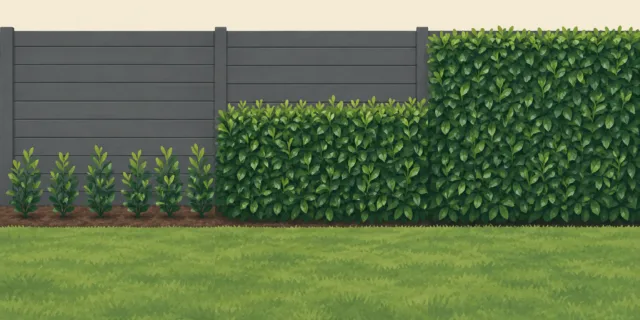 Fast-growing hedges: how much each grows in a year
The fastest hedge plant is the Leyland cypress, growing about 90 cm a year, followed by cherry laurel 'Novita', firethorn and western red cedar at about 50 cm a year, then privet at 40 cm. How long a 180 cm hedge takes to screen depends more on the size of plant you buy: several years from small plants, one or two summers from large ones, but at many times the price per metre. The tables use the current shop prices in your country.
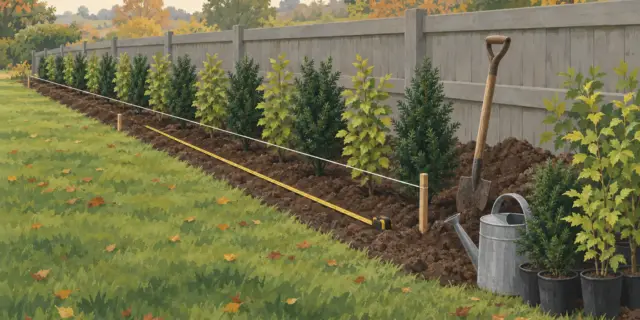 Planting a hedge: how many plants per metre, and what it costs
Most hedge plants go in at 2-4 plants per metre: Leyland cypress 2, cherry laurel and photinia 2.5 (40 cm apart), yew 3, hornbeam 3.5, privet and beech 4. The plants go in one row, 80 cm from the fence, in autumn or early spring. What the hedge costs depends most on the size of the plants: the table works it out at today's shop prices in your country, for the length of your own hedge.
 Planting and pruning lavender: when, where, how much to cut
Lavender wants a sunny spot and loose, free-draining soil, and likes limy soil too; plant it in spring, in April or May, 30-45 cm apart for a hedge. Prune it twice a year: in spring, in late March or April once hard frosts are over, cut the shoots back by about two thirds, but always only into green, leafy growth; after flowering, in late July or August, take off the faded flower stalks with the top 2-3 centimetres of leaves, shaping a dome. Never cut into the bare, woody part, as lavender does not regrow from it. English lavender and 'Hidcote' survive hard winters, lavandin is a little more tender, and French lavender takes only mild winters.
Besides the cookies the site needs to work, we would like to use analytics and advertising cookies (Google, Facebook), if you allow it. Details