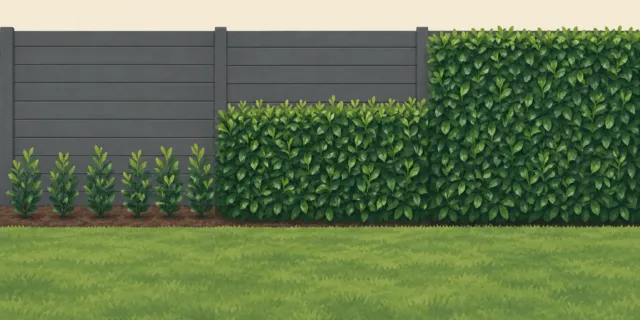
Thuja plicata
Western red cedar (Thuja plicata) is a hedge plant that reaches 5 m × 2 m after ten years. Light: full sun, part shade. Hardy down to -29 °C. Drought tolerance: low. Toxic to children. Sold in local shops from about €3.

A fast-growing evergreen with glossy dark green, scale-like foliage that smells of pineapple when crushed. For hedges it is mostly planted as the cultivars Atrovirens, Excelsa and Martin: it takes clipping well, quickly forms a dense, tall wall and tolerates part shade, but it needs trimming at least once a year, because left alone it becomes a tree of 15 to 30 metres. It wants moist, fertile, well-drained soil and regular watering and copes badly with dry soil, drying winds and hot, baking positions. All parts of the plant are poisonous.
| Group | Hedge |
| Light | Full sun, Part shade |
| Size after 10 years | 5 m × 2 m |
| Ultimate size | 15–30 m × 4.5–9 m |
| Hardiness | down to -29 °C (USDA 4, RHS H7) |
| Soil | Average garden soil, Clay, Acidic, Calcareous |
| Foliage | Evergreen |
| Flowering | no data |
| Water need | Medium |
| Drought tolerance | Low |
| Maintenance | Medium |
| Root aggressiveness | Low |
| Suckering | no |
| Spreading | Low |
| Distance from buildings | at least 1.5 m |
| Distance from paving | at least 0.5 m |
| Litter | not typical |
| Planting distance | 70 cm |
| For dogs | Toxic (uncertain) |
| For cats | Toxic (uncertain) |
| For children | Toxic |
| Typical price | from about €3 |
Toxicity data is for information only. If your pet or child has eaten a plant, contact a vet or a doctor.
The same plant is sold as a small pot and as a specimen several metres tall, and the price follows. Prices are rounded and for guidance only.
|
Size
|
Typical price
|
|---|---|
| 20-40 cm | approx. €5 |
| 20-30 cm | approx. €10 |
| 30-35 cm | approx. €11 |
| 180-200 cm | approx. €290 |
| size not stated | approx. €14 – €23 |
Data updated: October 8, 2026 · How our data is made
Besides the cookies the site needs to work, we would like to use analytics and advertising cookies (Google, Facebook), if you allow it. Details