Juniperus scopulorum
Rocky Mountain juniper (Juniperus scopulorum) is a shrub that reaches 4 m × 60 cm after ten years. Light: full sun. Hardy down to -34 °C. Drought tolerance: high.

Rocky Mountain juniper is sold as narrow, columnar, blue-green or silver-blue forms (Blue Arrow, Skyrocket): in ten years they reach roughly four metres while staying little more than half a metre wide. They fit tight spaces, gateways, vertical accents or a narrow screen planted in a row, and survive where Italian cypress would be killed by frost. They want full sun and free-draining soil, cope with lime and dry ground, and hardly need watering once established.
| Group | Shrub |
| Light | Full sun |
| Size after 10 years | 4 m × 60 cm |
| Ultimate size | 3.5–5 m × 0.6–1.5 m |
| Hardiness | down to -34 °C (USDA 4, RHS H7) |
| Soil | Average garden soil, Sandy, Clay, Calcareous |
| Foliage | Evergreen |
| Flowering | no data |
| Water need | Low |
| Drought tolerance | High |
| Maintenance | Low |
| Root aggressiveness | Low |
| Suckering | no |
| Spreading | Low |
| Distance from buildings | at least 2 m |
| Distance from paving | at least 0.5 m |
| Litter | not typical |
| Planting distance | 80 cm |
| For dogs | no data |
| For cats | no data |
| For children | Mildly toxic (uncertain) |
| Typical price | no data |
Toxicity data is for information only. If your pet or child has eaten a plant, contact a vet or a doctor.
Data updated: October 17, 2026 · How our data is made
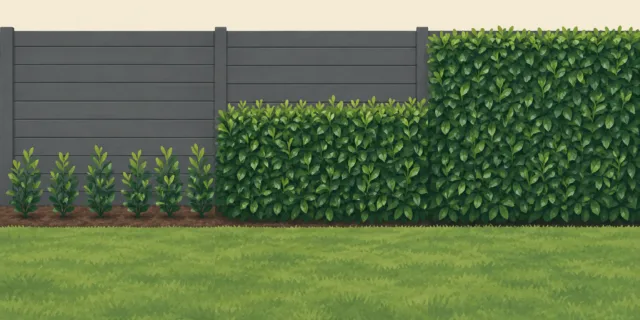 Fast-growing hedges: how much each grows in a year
The fastest hedge plant is the Leyland cypress, growing about 90 cm a year, followed by cherry laurel 'Novita', firethorn and western red cedar at about 50 cm a year, then privet at 40 cm. How long a 180 cm hedge takes to screen depends more on the size of plant you buy: several years from small plants, one or two summers from large ones, but at many times the price per metre. The tables use the current shop prices in your country.
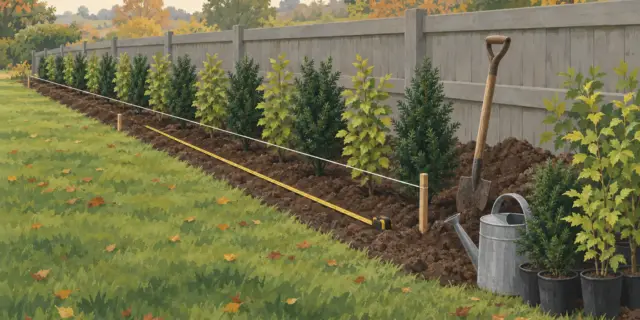 Planting a hedge: how many plants per metre, and what it costs
Most hedge plants go in at 2-4 plants per metre: Leyland cypress 2, cherry laurel and photinia 2.5 (40 cm apart), yew 3, hornbeam 3.5, privet and beech 4. The plants go in one row, 80 cm from the fence, in autumn or early spring. What the hedge costs depends most on the size of the plants: the table works it out at today's shop prices in your country, for the length of your own hedge.
Besides the cookies the site needs to work, we would like to use analytics and advertising cookies (Google, Facebook), if you allow it. Details