Lavandula angustifolia
English lavender (Lavandula angustifolia) is a perennial. Light: full sun. Hardy down to -29 °C. Drought tolerance: high. Toxic to dogs and cats. Sold in local shops from about PLN 10.

An evergreen, grey-leaved, scented subshrub covered for weeks in early summer with purple, blue, pink or white flower spikes that bees and butterflies love. It belongs in full sun and poor, limy, sharply drained soil, as a low hedge, a path edging or in a pot; in heavy, wet ground it dies within a few years. Cultivars differ mainly in size and colour: 'Hidcote', 'Hidcote Blue', 'Munstead', 'Essence Purple' and 'Dwarf Blue' are low, dense and darker flowered and make the best hedges, 'Rosea' is pink and 'Alba' white. Trim it every year after flowering down to the leafy part, but never cut into the old bare wood, because it does not reshoot from there. Lavandin (Lavandula × intermedia, for example 'Phenomenal' or 'Grosso'), often sold simply as lavender, is a separate, much larger and later flowering plant.
| Group | Perennial |
| Light | Full sun |
| Size after 10 years | 60 cm × 80 cm |
| Ultimate size | 30–90 cm × 0.6–1.2 m |
| Hardiness | down to -29 °C (USDA 4, RHS H7) |
| Soil | Average garden soil, Sandy, Calcareous |
| Foliage | Evergreen |
| Flowering | June–August, purple, blue, pink, white |
| Water need | Low |
| Drought tolerance | High |
| Maintenance | Medium |
| Root aggressiveness | Low |
| Suckering | no |
| Spreading | Low |
| Distance from buildings | no data |
| Distance from paving | no data |
| Litter | not typical |
| Planting distance | 40 cm |
| For dogs | Toxic |
| For cats | Toxic |
| For children | Mildly toxic (uncertain) |
| Typical price | from about PLN 10 |
Toxicity data is for information only. If your pet or child has eaten a plant, contact a vet or a doctor.
The same plant is sold as a small pot and as a specimen several metres tall, and the price follows. Prices are rounded and for guidance only.
|
Size
|
Typical price
|
|---|---|
| size not stated | approx. PLN 10 – PLN 20 |
Data updated: October 26, 2026 · How our data is made
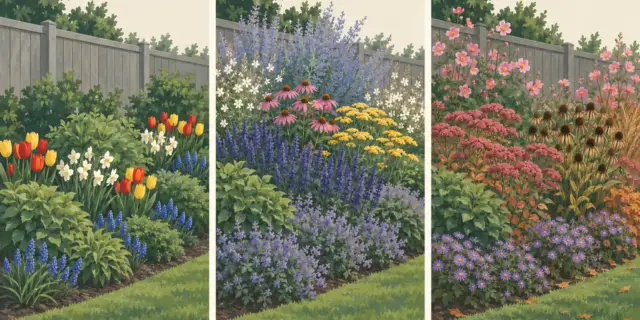 A perennial border that flowers all summer: plants, layout, numbers
A perennial border flowers from spring to autumn when its backbone is long-flowering perennials that bloom from June to September (catmint, woodland sage, coneflower, yarrow, Russian sage, gaura), with bulbs around them for spring and Japanese anemone, sedum and asters for autumn. Plant in groups of 3-7, tall at the back, low at the front; on average you need 5-7 plants per square metre. The calendars show the hardy perennials for a sunny spot that shops in your country sell most widely, with the price per plant.
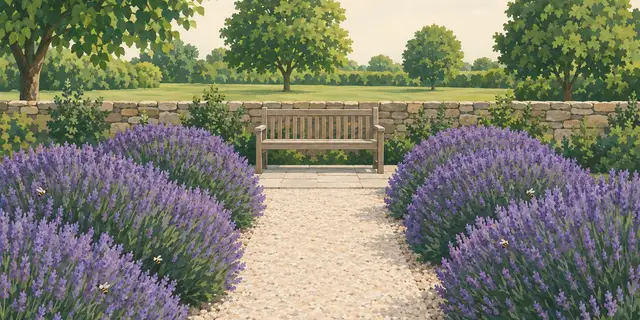 Planting and pruning lavender: when, where, how much to cut
Lavender wants a sunny spot and loose, free-draining soil, and likes limy soil too; plant it in spring, in April or May, 30-45 cm apart for a hedge. Prune it twice a year: in spring, in late March or April once hard frosts are over, cut the shoots back by about two thirds, but always only into green, leafy growth; after flowering, in late July or August, take off the faded flower stalks with the top 2-3 centimetres of leaves, shaping a dome. Never cut into the bare, woody part, as lavender does not regrow from it. English lavender and 'Hidcote' survive hard winters, lavandin is a little more tender, and French lavender takes only mild winters.
Santolina chamaecyparissus
Festuca glauca
Sedum sieboldii
Besides the cookies the site needs to work, we would like to use analytics and advertising cookies (Google, Facebook), if you allow it. Details