Planting tulips, daffodils and crocuses: when, how deep, how many
Spring-flowering bulbs go in in autumn: daffodils, crocuses and hyacinths from September to October, tulips from October to November, until the ground freezes. A bulb goes two to three times its own height deep (tulips and daffodils about 12-15 cm, crocuses 8-10 cm), tip up, at least twice its width from the next. Between perennials, 20 small, 8 medium and 4 large bulbs per square metre are enough. After flowering, leave their leaves on for six weeks.
Updated: October 28, 2026 · Prices checked: October 27, 2026 · Data and prices from our plant database, worked out for your country. How our data is made

When to plant?
Spring bulbs need a winter: without weeks of cold they do not flower. So they go into the ground in autumn, to root before the frosts. Daffodils, crocuses, hyacinths and grape hyacinths can be planted from September to the end of October; the earlier the better, as their roots start early.
Plant tulips later, from October to November, once the soil has cooled. A tulip planted in warm, wet soil can shoot too early and rots more easily. As long as the ground is not frozen, you can still plant in December what you missed in autumn. A tulip planted late hardly roots in the cold soil and flowers more weakly, but a bulb forgotten in a drawer will have dried out by spring.
Do not plant dry bulbs in spring: without a winter they flower weakly or not at all. Potted tulips, hyacinths and daffodils sold in flower in spring, however, can go out into the garden after flowering: daffodils and hyacinths recover within a year or two, but do not expect much from forced tulips.
Which bulb flowers when?
Plant one from each flowering time and the garden flowers from February to June: winter aconite and crocus push up through the snow, then come Grecian windflower, grape hyacinth, hyacinth and daffodil, in April and May tulip and crown imperial, and last camassia and ornamental onion.

- Flowering
- February–March, yellow
- Height
- 8–15 cm
- Planting depth
- 5-8 cm
- Between perennials, per square metre
- 20 pcs
- Year after year
- comes back and spreads

- Flowering
- February–April, purple, white, yellow
- Height
- 8–15 cm
- Planting depth
- 8-10 cm
- Between perennials, per square metre
- 20 pcs
- Year after year
- comes back and spreads

- Flowering
- March–May, blue, purple, pink, white
- Height
- 10–20 cm
- Planting depth
- 5-8 cm
- Between perennials, per square metre
- 20 pcs
- Year after year
- comes back and spreads

- Flowering
- March–May, blue, purple, white, pink
- Height
- 15–25 cm
- Planting depth
- 8-10 cm
- Between perennials, per square metre
- 20 pcs
- Year after year
- comes back and spreads

- Flowering
- March–May, blue, purple, pink, red, white, yellow, orange
- Height
- 15–30 cm
- Planting depth
- 12-15 cm
- Between perennials, per square metre
- 20 pcs
- Year after year
- weakens year by year

- Flowering
- March–May, yellow, white, orange, pink
- Height
- 15–75 cm
- Planting depth
- 12-15 cm
- Between perennials, per square metre
- 8 pcs
- Year after year
- comes back and spreads

- Flowering
- April–May, white, yellow, orange, red, pink, purple
- Height
- 20–75 cm
- Planting depth
- 12-15 cm
- Between perennials, per square metre
- 8 pcs
- Year after year
- weakens year by year

- Flowering
- April–May, orange, yellow, red
- Height
- 0.9–1.2 m
- Planting depth
- 20-25 cm
- Between perennials, per square metre
- 4 pcs
- Year after year
- weakens year by year

- Flowering
- April–June, blue, purple, white
- Height
- 0.8–1.2 m
- Planting depth
- 10-15 cm
- Between perennials, per square metre
- 4 pcs
- Year after year
- comes back and spreads

- Flowering
- May–July, purple, white, pink
- Height
- 0.4–1.5 m
- Planting depth
- 15-20 cm
- Between perennials, per square metre
- 4 pcs
- Year after year
- comes back and spreads
|
Bulb
|
Flowering
|
Height
|
Planting depth
|
Between perennials, per square metre
|
Year after year
|
|---|---|---|---|---|---|
| February–March, yellow | 8–15 cm | 5-8 cm | 20 pcs | comes back and spreads | |
| February–April, purple, white, yellow | 8–15 cm | 8-10 cm | 20 pcs | comes back and spreads | |
| March–May, blue, purple, pink, white | 10–20 cm | 5-8 cm | 20 pcs | comes back and spreads | |
| March–May, blue, purple, white, pink | 15–25 cm | 8-10 cm | 20 pcs | comes back and spreads | |
|
Hyacinth
toxic
|
March–May, blue, purple, pink, red, white, yellow, orange | 15–30 cm | 12-15 cm | 20 pcs | weakens year by year |
|
Daffodil
toxic
|
March–May, yellow, white, orange, pink | 15–75 cm | 12-15 cm | 8 pcs | comes back and spreads |
|
Garden tulip
toxic
|
April–May, white, yellow, orange, red, pink, purple | 20–75 cm | 12-15 cm | 8 pcs | weakens year by year |
| April–May, orange, yellow, red | 0.9–1.2 m | 20-25 cm | 4 pcs | weakens year by year | |
| April–June, blue, purple, white | 0.8–1.2 m | 10-15 cm | 4 pcs | comes back and spreads | |
|
Ornamental onion
toxic
|
May–July, purple, white, pink | 0.4–1.5 m | 15-20 cm | 4 pcs | comes back and spreads |
The table shows the bulbs sold as bulbs that are planted in autumn and are hardy in an average winter. The number per square metre is our garden planner's rule for scattering them sparsely between perennials; a dense patch of bulbs alone takes several times as many.
How deep and how close?
- Depth: the base of the bulb goes two to three times the bulb's height below the surface, small bulbs rather three times or a little deeper. A bulb planted too shallow stops flowering in its second or third year.
- Which way up: the tip of the bulb up, the flat, rooted base down. On a Grecian windflower tuber you cannot tell which is the top: soak it overnight and plant it on its side; it finds its way.
- Spacing: set bulbs at least twice their width apart. Plant them in groups of 7-15, not in rows: a single tulip gets lost, a patch shows from afar.
- Between perennials: scatter bulbs among the summer-flowering perennials, where the soil is still bare in spring. By the time the bulbs' leaves start to yellow, the perennials have grown up and hide them.
- In the lawn: crocuses, grape hyacinths and daffodils can go into the lawn too, where they spread year after year. Mow only once the bulbs' leaves have turned yellow, about six weeks after flowering.
Where to plant?
- Somewhere free-draining: a bulb rots in standing water. On heavy clay, put 2-3 cm of coarse sand or fine gravel at the bottom of the hole.
- In sun or part shade. You can plant under deciduous trees and shrubs too: bulbs flower before the trees are in leaf, while the sun still reaches the ground.
- Tulips like a sunny, warm spot that is dry in summer best; there they come back most reliably year after year. Daffodils and crocuses take part shade and lawn well.
Planting step by step
- Dig over the soil and take out perennial weeds. Mix in a little ripe compost; keep fresh manure away from bulbs, as it makes them rot.
- Dig one shared, shallow hole for the patch (quicker than one per bulb), or use a bulb planter.
- Set the bulbs in the hole, tips up, cover with soil and firm it gently.
- If the autumn is dry, water once, deeply. After that no watering is needed; winter rain and snow are enough.
- Mark the spot with a stick or label so that you do not dig into it in spring before they come up.
Voles, mice and pets
Voles and mice readily eat tulip and crocus bulbs, but mostly leave daffodils alone because of their bitter, poisonous content. Where there are many voles, plant tulips in a wire bulb basket or between wire mesh with holes of about 1 cm, or choose daffodils.
Daffodils, tulips, hyacinths and ornamental onions are poisonous to dogs and cats; they are marked in the table. Winter aconite, crown imperial and Grecian windflower are not harmless either. Where the dog likes to dig, grape hyacinth is the better choice, which our data lists as non-toxic.
After flowering
- Pinch off faded tulip and daffodil flowers above the leaves so they do not set seed: the bulb grows stronger.
- Leave the leaves on until they yellow by themselves, about six weeks, and do not tie them: the leaves feed next year's flower. Then you can cut them off.
- For good flowers next year too, give them a potassium-rich liquid feed from when they shoot until the leaves yellow, at the dose on the pack.
- Garden tulips weaken year by year, and in the second year often hardly flower. Darwin hybrids, Kaufmanniana tulips and species (wild) tulips come back most reliably. You can lift the others once the leaves have yellowed, keep them through summer in a dry, airy, warm place, and plant them again in autumn.
- Daffodils, crocuses, grape hyacinths and ornamental onions can stay where they are and spread year after year. If a patch becomes crowded and flowers less, lift and divide it once the leaves have yellowed.
Bulbs in pots and tubs
- In pots, bulbs can go close together, almost touching: a 45 cm tub takes about 12-20 tulips. Mix a quarter of fine gravel or coarse sand into the compost, and keep the surface about 2.5 cm below the rim.
- You can plant in layers too: the large, deep bulbs at the bottom (tulip, daffodil), the small ones above them (crocus, grape hyacinth). That way the same pot flowers for weeks.
- In winter, stand the pot by the house wall in a sheltered spot, and do not let the compost dry out. Bulbs grown in a pot flower less well in their second year, so it is worth planting new ones every year and planting the old ones out in the garden.
Sources
The advice rests on these expert pages and laws, adapted to Central European winters and soils. The tables come from our own plant database.
- Natur im Garten: Jetzt Blumenzwiebel für den Frühling setzen
- Bayerische Gartenakademie: Letzte Chance für späte Pflanzungen im Garten
- RHS: Bulbs: planting
- RHS: How to grow tulips
More guides
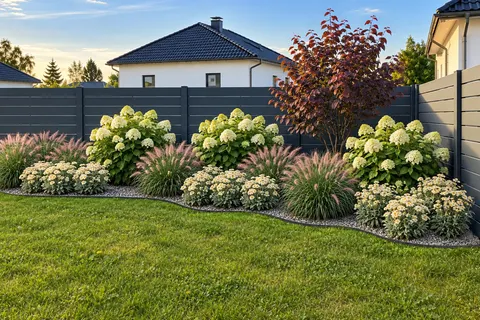 How to plan a garden, step by step
A garden is best planned in six steps: survey the site (light, soil, water, winter), decide what you will use it for, set the framework that still shows in winter, then lay out the border in layers, tall at the back and low at the front. Choose plants so that something flowers from spring to autumn, and finally work out the number of plants and the cost from the planting distances. Our garden planner works by the same rules.
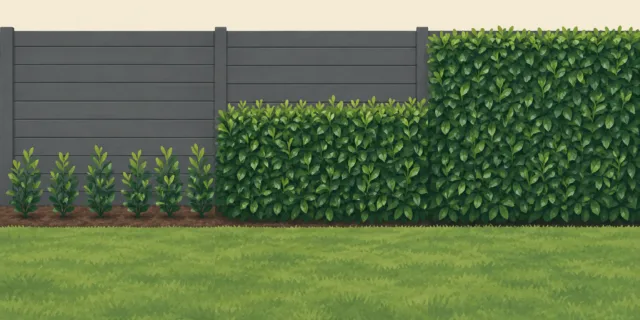 Fast-growing hedges: how much each grows in a year
The fastest hedge plant is the Leyland cypress, growing about 90 cm a year, followed by cherry laurel 'Novita', firethorn and western red cedar at about 50 cm a year, then privet at 40 cm. How long a 180 cm hedge takes to screen depends more on the size of plant you buy: several years from small plants, one or two summers from large ones, but at many times the price per metre. The tables use the current shop prices in your country.
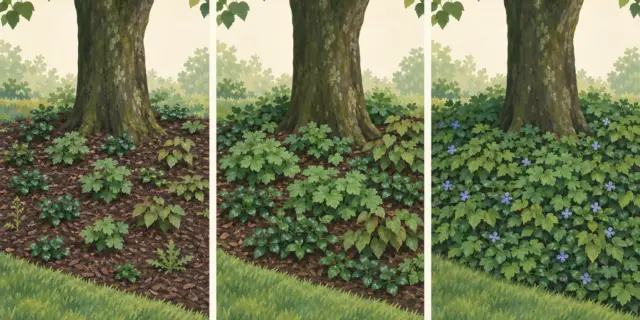 Ground cover plants against weeds: which goes where, and how many you need
A ground cover keeps weeds out once it has closed up: until then, usually for two or three summers, it needs mulch and weeding. Under trees and in shade, lesser periwinkle, bigroot geranium, barrenwort and barren strawberry do best; in sunny, dry places stonecrops, thymes and creeping junipers. Most perennial ground covers take 9-18 plants per square metre. The tables work out what a square metre costs at today's shop prices in your country.
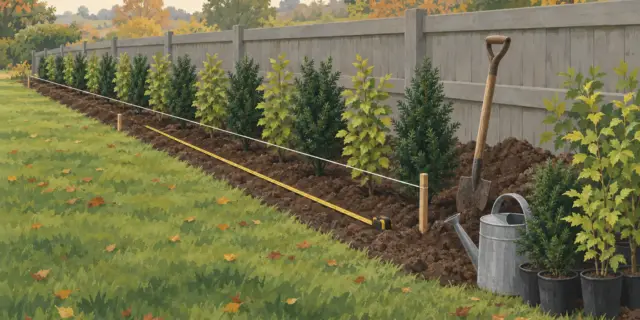 Planting a hedge: how many plants per metre, and what it costs
Most hedge plants go in at 2-4 plants per metre: Leyland cypress 2, cherry laurel and photinia 2.5 (40 cm apart), yew 3, hornbeam 3.5, privet and beech 4. The plants go in one row, 80 cm from the fence, in autumn or early spring. What the hedge costs depends most on the size of the plants: the table works it out at today's shop prices in your country, for the length of your own hedge.
 Building a rock garden: stone, soil and plants step by step
A rock garden belongs on a sunny, gentle slope, in lean, free-draining soil: one third garden soil, one third coarse sand, one third crushed stone. Lay the stones, all of one kind, in layers leaning the same way and sunk a third to a half into the ground, so that about two fifths of the surface is stone. Four to six plants per square metre are enough: creeping junipers and grasses make the frame, and between them cushion perennials, stonecrops and thymes flower from March to October.
 A perennial border that flowers all summer: plants, layout, numbers
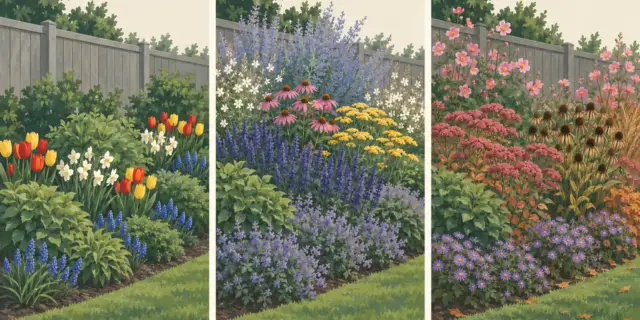
A perennial border flowers from spring to autumn when its backbone is long-flowering perennials that bloom from June to September (catmint, woodland sage, coneflower, yarrow, Russian sage, gaura), with bulbs around them for spring and Japanese anemone, sedum and asters for autumn. Plant in groups of 3-7, tall at the back, low at the front; on average you need 5-7 plants per square metre. The calendars show the hardy perennials for a sunny spot that shops in your country sell most widely, with the price per plant.
 Planting and pruning hydrangeas: which to cut back when
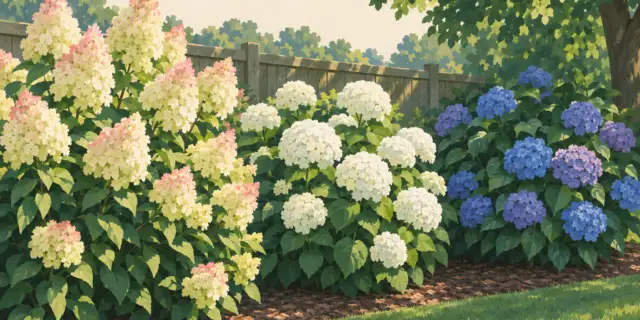
For pruning, hydrangeas fall into two groups. Panicle and smooth hydrangeas (such as 'Annabelle') flower on this year's shoots: cut them back to 25-60 cm in February or March. Bigleaf and mountain hydrangeas flower from buds that grew last year: in spring take off only the faded flowers, or they will not flower that year. Plant in autumn or spring, with plenty of water; for limy soil choose panicle or smooth hydrangea, as bigleaf hydrangea wants acid or neutral soil and afternoon shade.
 Planting and pruning lavender: when, where, how much to cut
Lavender wants a sunny spot and loose, free-draining soil, and likes limy soil too; plant it in spring, in April or May, 30-45 cm apart for a hedge. Prune it twice a year: in spring, in late March or April once hard frosts are over, cut the shoots back by about two thirds, but always only into green, leafy growth; after flowering, in late July or August, take off the faded flower stalks with the top 2-3 centimetres of leaves, shaping a dome. Never cut into the bare, woody part, as lavender does not regrow from it. English lavender and 'Hidcote' survive hard winters, lavandin is a little more tender, and French lavender takes only mild winters.