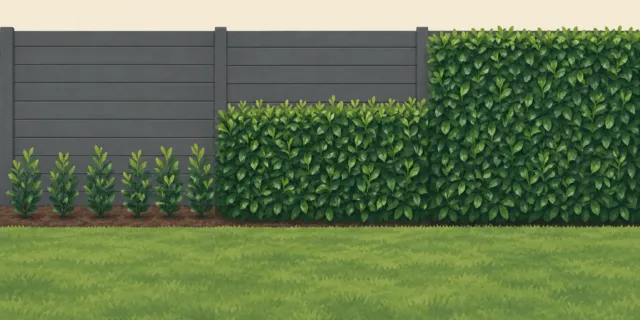
Prunus laurocerasus
Cherry laurel (Prunus laurocerasus) is a hedge plant. Light: full sun, part shade, shade. Hardy down to -23 °C. Drought tolerance: medium. Toxic to dogs, cats and children. Sold in local shops from about €4.90.

A fast-growing evergreen with glossy leaves and one of the most popular hedging plants: it grows in sun and shade alike and takes hard pruning well. Cultivars differ in size, leaf shape and above all winter hardiness: Rotundifolia with its large light green leaves is the fastest but the most frost-tender, Caucasica, Herbergii, Etna and the narrow columnar Genolia stand cold better, while Otto Luyken and Mount Vernon stay low and spreading, so choose by the hedge height you want and by hardiness. All parts are poisonous and birds spread its seed, so trim it after flowering to stop it setting fruit.
| Group | Hedge |
| Light | Full sun, Part shade, Shade |
| Size after 10 years | 3 m × 2.5 m |
| Ultimate size | 0.6–6 m × 1–4 m |
| Hardiness | down to -23 °C (USDA 6, RHS H7) |
| Soil | Average garden soil, Sandy, Acidic |
| Foliage | Evergreen |
| Flowering | April–May, white |
| Water need | Medium |
| Drought tolerance | Medium |
| Maintenance | Medium |
| Root aggressiveness | Low |
| Suckering | no |
| Spreading | Medium |
| Distance from buildings | at least 1.5 m |
| Distance from paving | at least 0.5 m |
| Litter | not typical |
| Planting distance | 80 cm |
| For dogs | Toxic |
| For cats | Toxic |
| For children | Toxic |
| Typical price | from about €4.90 |
Toxicity data is for information only. If your pet or child has eaten a plant, contact a vet or a doctor.
The same plant is sold as a small pot and as a specimen several metres tall, and the price follows. Prices are rounded and for guidance only.
|
Size
|
Typical price
|
|---|---|
| 30-40 cm | approx. €13 |
| 30-50 cm | approx. €14 |
| 80-100 cm | approx. €15 |
| 90-110 cm | approx. €100 |
| 120-130 cm | approx. €80 |
| 180-220 cm | approx. €80 |
| 180 cm | approx. €120 |
| size not stated | approx. €4.90 – €27 |
Data updated: October 13, 2026 · How our data is made
Besides the cookies the site needs to work, we would like to use analytics and advertising cookies (Google, Facebook), if you allow it. Details